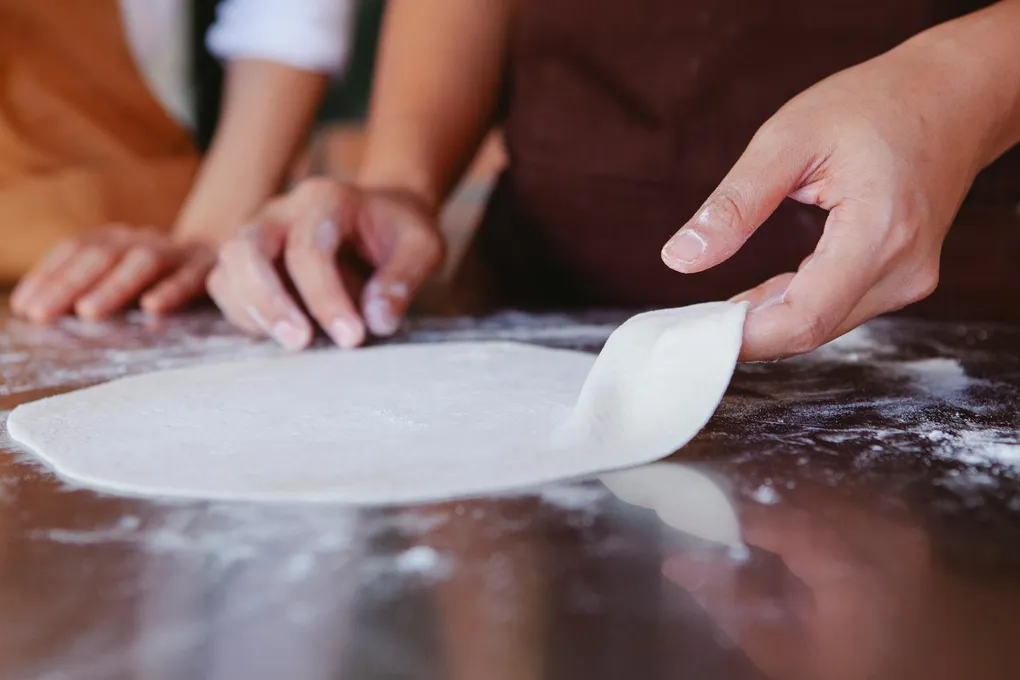
Stretching pizza dough is where most home bakers hit their first real wall. The dough snaps back like a rubber band, tears appear out of nowhere, and by the time you’ve wrestled it into something vaguely round, the shape looks like a map of an undiscovered country. And yet professional pizzaioli stretch hundreds of balls a night with barely a glance.
The gap isn’t talent — it’s understanding. Tearing happens for specific, diagnosable reasons, and the stretching method you choose should match your dough and your style. Three world-class pizza makers teach three distinct approaches: Forkish’s fingertip press, Gemignani’s slap-and-flip, and Iacopelli’s counter-supported pull. Each works. Each suits different situations.
Why Dough Tears
Before we fix the technique, let’s fix the dough. No stretching method in the world saves under-proofed dough.
Under-proofed dough is the number-one cause of tearing. When dough hasn’t fermented long enough, the gluten network is still tight and elastic — it resists deformation and snaps back. Masi’s science explains this precisely: maturation is the enzymatic process where proteases gradually break down gluten proteins, transforming the dough from elastic (snaps back) to extensible (stretches freely). Insufficiently matured dough springs back and tears rather than flowing.
Cold dough tears for a related reason. Gluten tightens when cold. Gemignani’s Commandment #5 is “never put cold dough in a hot oven,” but it applies to stretching too. Pull dough from the fridge at least 1-2 hours before shaping. Target 60-65F internal temperature — check with an instant-read thermometer.
Over-proofed dough tears differently — not from resistance, but from structural failure. The gluten network has degraded too far and can no longer hold together. The dough feels slack, sticky, and falls apart under its own weight. Iacopelli’s rescue: gently re-ball it and rest for an hour. The gluten partially recovers.
Over-degassed dough has lost the gas bubbles that give it loft and pliability. If you punched down your dough aggressively or handled it roughly, you expelled the CO2 that makes it light. Gemignani warns: when dough balls come out of the fridge, they’ve naturally flattened into disks — do NOT punch them down or reshape into balls. That flat disk gives you “a huge head start” on even stretching.
The Three Methods
Method 1: Fingertip Press and Gravity Stretch (Forkish)
This is the gentlest approach and the best starting point for beginners. It works especially well for high-hydration doughs (68-75%) that are too fragile for aggressive handling.
Step 1: Decompress. Place a mature, relaxed dough ball on a well-floured surface. Using your fingertips (not your palms), press gently from the center outward in a series of small pushes. Work in concentric rings, moving from center toward the edge. Leave the outer inch completely untouched — this becomes the cornicione (rim). The goal is to push gas from the center into the edges.
Step 2: Flip and repeat. Turn the dough over and repeat the fingertip pressing. This ensures even thickness on both sides and helps the dough relax.
Step 3: Gravity stretch. Pick up the dough and drape it over both fists (knuckles facing up, hands about 6 inches apart). Let gravity pull the dough downward. Slowly rotate the dough by walking your fists around its perimeter. The weight of the dough does the stretching — you’re just supporting and rotating.
Step 4: Final check. Lay the dough on the peel or work surface. Gently adjust any thick spots with your fingertips.
Best for: Neapolitan and Roman styles. High-hydration dough. Beginners. When you want the most delicate, light crust.
Why it works: Fingertips are more precise than palms and less likely to accidentally thin the center too much. The gravity stretch uses the dough’s own weight rather than mechanical force, which preserves the gas structure in the rim.
Method 2: Slap-and-Flip (Gemignani)
This is the competition method — flashier, faster, and suited for drier, stiffer doughs (60-66% hydration) that can handle more aggressive manipulation.
Step 1: Preserve the disk. Your dough ball has flattened in the fridge into a disk shape. Gently peel it off its container and transfer to a bowl of dusting mixture (50/50 flour and fine semolina — the semolina acts as “mini ball bearings” for sliding). Coat completely.
Step 2: Define the cornicione. On the floured counter, press the dough starting 3/4 inch from the edge, working all the way around. Leave the rim untouched. Gemignani’s rule: “Leave the middle alone — the middle takes care of itself.” Only work the edges.
Step 3: Counter stretch. Place your fingertips flat just inside the 3/4-inch rim. Slide your hands apart 1-2 inches, stretching that section of the perimeter. Rotate the dough 10 degrees and repeat. Continue around the full circle until the dough reaches about 11 inches.
Step 4: Hand-to-hand slapping. Pick up the dough and gently flip it between your open palms, rotating slightly each time. This uses centrifugal force and the dough’s weight to stretch it further.
Step 5: Fist technique. Drape the dough over two loosely clenched fists. Gently toss it into the air with a slight rotation. This is optional — hold the dough up to the light to check for thin spots before deciding if it needs more stretching.
Step 6: Target size. For a 370g dough ball, aim for 12-13 inches. Better to understretch (slightly thicker) than overstretch (thin spots that become holes). “The more gently you handle your dough, the more tender your finished crust will be.”
Best for: New York style, competition pizza, stiffer doughs. Experienced bakers who are comfortable with airborne dough.
Why it works: The hand-to-hand motion and fist-draping use gravity and inertia to stretch the dough uniformly. The centrifugal force of the toss naturally thins the center more than the edges (which have more mass). The semolina dusting prevents sticking during the aggressive handling.
Method 3: Counter-Supported Pull-and-Rotate (Iacopelli)
This is the home baker’s method — designed specifically for high-hydration, fragile dough on a kitchen counter. No airborne tossing. Maximum control.
Step 1: Remove with a spatula. Never pull dough from its proofing container with bare hands. Flour the dough ball while it’s still in the container, then slide a spatula under it vertically. Transfer to a bowl of flour, coat completely, then to the counter.
Step 2: Palm press. Both palms flat and slightly cupped, fingers together, thumbs lifted. Press the center of the dough, moving in small circular motions outward. “No stretch, just press” — you’re pushing air toward the edges, not thinning the center. Leave about 1 inch of rim untouched. Flip and repeat on the other side.
Step 3: The pull-and-rotate. This is the core technique. Your right hand acts as an anchor: palm flat, pressing just inside the cornicione, stationary. Your left hand does the work: cupped fingertips grip just inside the rim opposite your right hand, then make a swift outward pull of 1-2 inches. As the left hand pulls and releases, the right hand slightly lifts and rotates the dough about 10-15 degrees. Repeat rapidly around the full circumference.
The dough stays on the counter the entire time. It’s a rhythmic, grounded motion — more like shaping pottery than tossing pizza.
Step 4: Transfer. Shake off excess flour, then do a final gentle expansion on the peel before launching.
Best for: Home bakers working with wet, soft dough. High-hydration Neapolitan. Anyone who’s not comfortable with airborne dough. This is the most forgiving method.
Why it works: Keeping the dough on the counter means gravity can’t tear it. The anchor hand controls how much force the stretching hand can apply. The rotation ensures even stretching around the full perimeter. The flat-palm initial press (rather than fingertips) spreads force over a larger area, reducing the chance of poking holes in fragile dough.
Choosing Your Method
| Factor | Forkish Fingertip | Gemignani Slap-and-Flip | Iacopelli Counter Pull |
|---|---|---|---|
| Hydration | 65-75% | 60-66% | 65-75% |
| Dough strength | Moderate to fragile | Strong, elastic | Moderate to fragile |
| Skill level | Beginner | Intermediate-Advanced | Beginner |
| Best style | Neapolitan, Roman | New York, competition | Home Neapolitan |
| Dough airborne? | Yes (gravity stretch) | Yes (toss, slap) | No (stays on counter) |
| Speed | Moderate | Fast | Moderate |
When Dough Resists: The Snap-Back Problem
You’re pressing outward and the dough keeps shrinking back to its original size. This is elastic recoil, and it means the gluten hasn’t relaxed enough.
Immediate fix: Stop stretching. Let the dough rest on the counter for 5-10 minutes, covered loosely with plastic or an inverted bowl. Gluten is viscoelastic — it relaxes over time. After rest, it’ll stretch more willingly. You can repeat this rest multiple times.
Root cause fix: Your dough probably needs more fermentation time. Protease enzymes break down gluten during fermentation, converting it from elastic to extensible. A dough that fights you hard during stretching is almost certainly under-matured. Masi specifies: properly matured dough sustains both uniaxial (lengthening) and biaxial (finger stretching) forces without tearing or snapping back.
Iacopelli offers a brilliant diagnostic from his three-gluten-structures experiment: the same dough, with no ingredient changes, produces three different textures based solely on how long it rests before balling. A 20-minute rest before balling transforms dense, small-celled crumb into an airy, balanced structure with larger pockets. Time — not force — makes dough cooperative.
Rescuing Tears
A small tear (under 1 inch) can usually be pinched closed. Press the edges of the tear together firmly, then let that area rest for a moment before continuing to stretch elsewhere. When you lay the pizza on the peel, place it tear-side-down so the hot baking surface seals it.
A large tear or multiple tears means the dough is too damaged to save in its current shape. Re-ball it: gently fold the edges back to the center, flip it seam-side down, and let it rest for 30-60 minutes covered. The gluten network recovers partially. It won’t be as good as a fresh ball, but it’s workable.
If tears happen repeatedly, the problem isn’t your technique — it’s your dough. Check flour protein (need 11%+ for pizza), fermentation time (is the dough fully matured?), and temperature (is it warm enough to be extensible?).
The Peel Transfer
Stretching is only half the battle. Getting the shaped dough onto a peel without it sticking or collapsing is the second challenge.
Before you stretch: Have your peel dusted and ready. Gemignani recommends a 50/50 mixture of flour and fine semolina. For home ovens at 500-550F, either flour, semolina, or a blend works (flour doesn’t burn at these temperatures). For portable ovens at 800F+, use semolina only — flour burns and creates bitter, acrid smoke.
The speed rule: Once dough hits the peel, the clock starts. Moisture from the dough begins penetrating the dusting layer immediately. Build your pizza quickly — sauce, cheese, toppings — then do the “hovercraft test” before launching: shake the peel laterally and the entire pizza should slide freely. If any part sticks, lift that edge and add more dusting underneath.
The launch: Hold the peel level and parallel to the baking surface (not angled downward). Position it so the pizza is directly over where you want it to land. Quick push-and-pull: the far end of the pizza touches the stone, you immediately pull the peel sharply toward you while keeping it low and level. Gemignani compares it to the tablecloth magic trick. No throwing, no sliding through air.
Done right, the dough moves from counter to peel to oven in under 90 seconds. Done slowly, it sticks to the peel and your evening takes a dark turn. Speed and preparation are the entire game.