The most important thing to know about pizza sauce is that most of the time, you shouldn’t cook it.
This surprises people. We’re conditioned to think of tomato sauce as something that simmers on the stove for hours. But pizza sauce isn’t pasta sauce. The pizza oven is the cooking vessel. When you spread raw sauce on dough and bake it at 500-900F, the sauce cooks in the oven — concentrating, caramelizing, and melding with the dough and cheese. Pre-cooking it means cooking it twice, which destroys the fresh tomato brightness that great pizza sauce should have.
Here’s why different styles treat sauce differently, and the three base approaches that cover everything from Neapolitan to deep dish.
The No-Cook Consensus
Across seven authoritative sources — Forkish, Gemignani, Masi, Myhrvold, Iacopelli, and practitioners from Naples to New York — there’s remarkable agreement: for most pizza styles, sauce should not be cooked before it goes on the dough.
Forkish states it plainly: “The sauce is nothing more than canned tomatoes — whole peeled tomatoes from southern Italy — pureed with salt.” No cooking required.
Gemignani’s reasoning: tomatoes are already “cooked” during the canning process (high-pressure heat sterilization). They’ll cook again on the pizza. Simmering them beforehand results in overcooked sauce with diminished fresh flavor.
The exceptions exist for a reason. Detroit sauce is simmered because it’s ladled on after baking as “racing stripes” — it needs to be fully seasoned and ready to eat. Chicago deep-dish sauce, per Gemignani, is actually uncooked — it’s also added after baking to keep it bright and fresh-tasting. The Meatball Marinara sauce is the one that gets a quick simmer.
Style Determines Sauce
The way sauce is prepared and applied varies by style, and each variation exists to solve a specific problem.
Neapolitan: The purest expression. San Marzano tomatoes passed through a food mill with fine screen, plus salt. Nothing else. The sauce is intentionally thin — you should be able to see the dough through it. Gemignani’s Napoletana sauce is literally just two cans of Strianese San Marzano and salt. At 900F for 90 seconds, this thin sauce concentrates perfectly.
New York: Slightly more complex. A blend of ground tomatoes and tomato paste gives the sauce body that stands up to the heavier cheese load and longer bake time. Still uncooked. Gemignani’s NY-NJ sauce: 120g ground tomatoes + 65g tomato paste + oregano + salt + EVOO, pureed, then 55g of hand-crushed tomatoes stirred in for texture. Make it a day ahead for the flavors to marry.
Deep dish: The thickest, most heavily seasoned sauce in the pizza world. It has to be, because deep dish applies sauce on top of cheese in a thick layer that functions almost as a stew. Gemignani’s deep-dish sauce: 170g tomato paste + 85g ground tomatoes + 255g hand-crushed + oregano + salt + EVOO. Crucially, he adds it after baking for brighter flavor — the sauce warms against the hot pizza without being baked to death.
Detroit: A cooked sauce applied in “racing stripes” on top of the cheese after the pizza comes out of the oven. 28oz crushed San Marzano simmered 30 minutes with garlic, EVOO, oregano, onion powder, red pepper, sugar, and salt. This is one of the few pizza sauces that benefits from simmering because it’s a finishing element, not a baking component.
The Three Base Recipes
These three preparations cover the full spectrum of pizza sauce needs. Master them and you can sauce any style.
1. Smooth Raw Sauce (Neapolitan, New York, most styles)
Makes enough for 5 pizzas
- 1 (28-oz) can whole peeled San Marzano tomatoes
- 1.5 tablespoons extra virgin olive oil
- 1/2 teaspoon fine sea salt
- 1/4 teaspoon dried oregano (optional)
- 1/4 teaspoon chile flakes (optional)
- 1 clove garlic, minced (optional)
Drain tomatoes in a colander for 10-15 minutes (this step matters — excess liquid makes pizza soggy). Blend until smooth with an immersion blender or food processor. Stir in oil, salt, and optional seasonings.
Do not cook. Use immediately or refrigerate up to 5 days.
This is Forkish’s base recipe from FWSY. The 10-15 minute drain is critical — canned tomatoes ship in a packing liquid that’s often darker and more acidic than the tomatoes themselves. Gemignani advises rinsing whole tomatoes after draining to remove this liquid.
2. Chunky Raw Sauce (pan pizza, al taglio, rustic styles)
Makes enough for 2-3 pizzas
Same canned San Marzano tomatoes, drained. Instead of blending, push through a colander with a wooden spoon for about 30 seconds to break into chunky pulp. Stir in 1.5 tablespoons EVOO and salt to taste.
The texture provides visual interest and a more rustic, less uniform appearance. Good for thick-crust styles where sauce sits in a thicker layer and chunkiness is desirable.
Roasted variation: Break each tomato into 3-4 pieces by hand. Slow-roast at 325F for 20-30 minutes with EVOO, salt, and thyme. This concentrates the flavor and reduces moisture — excellent for pan pizza and deep-dish applications where excess liquid is the enemy.
3. Seasoned Cooked Sauce (Detroit, deep-dish finishing)
Makes enough for 1 Detroit or deep-dish pizza
- 28 oz crushed San Marzano tomatoes
- 4 cloves garlic, minced
- 2 tablespoons olive oil
- 2 teaspoons dried oregano
- 1 teaspoon onion powder
- 1/2 teaspoon red pepper flakes
- 1 tablespoon sugar
- Salt to taste
Saute garlic in olive oil until fragrant (30 seconds). Add remaining ingredients. Simmer 30 minutes, stirring occasionally. Blend smooth if desired.
This sauce is designed to be applied after baking — ladled in stripes on Detroit, poured over deep-dish — so it needs to be a complete, ready-to-eat sauce on its own.
Gemignani’s Style-Specific Sauces: Quick Reference
Gemignani provides eight distinct sauces in The Pizza Bible, each tuned to its style:
| Sauce | Key Difference | Cooked? |
|---|---|---|
| Napoletana | Just San Marzano + salt. Food mill. | No |
| NY-NJ | Ground tomatoes + paste, pureed, then hand-crushed stirred in | No |
| Detroit | Ground tomatoes + paste, pureed, warmed | Warm only |
| Deep-Dish | Heavy on paste, hand-crushed for texture. Added AFTER baking | No |
| St. Louis | Ground tomatoes + paste + Simple Syrup (sugar water) | No |
| Cracker-Thin | Ground tomatoes + paste + basil | No |
| Sicilian | Largest batch: ground + paste + hand-crushed + garlic + oregano | No |
| Meatball Marinara | Ground + paste + oregano + basil | Quick simmer |
The pattern: almost nothing is cooked. The sauces vary in thickness (controlled by the paste-to-tomato ratio), seasoning (minimalist for Neapolitan, more complex for regional American styles), and application timing (before baking for most, after baking for Detroit and deep-dish).
Tomato Selection
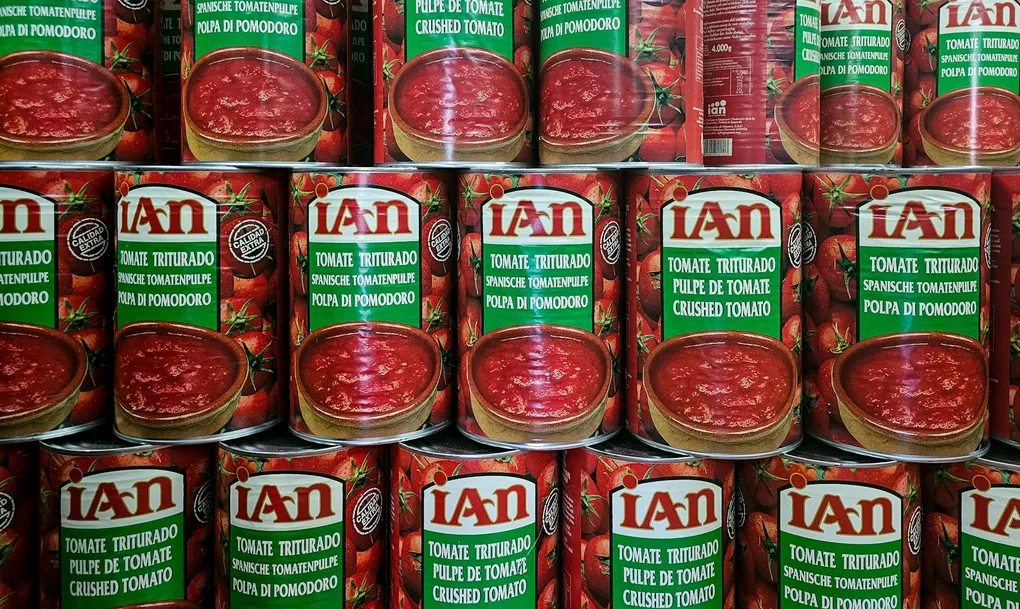
Not all canned tomatoes are equal. The sauce is 80-90% tomato, so tomato quality dominates the result.
What to look for:
- Whole peeled (not crushed or diced — those contain calcium chloride for firmness, which changes texture)
- San Marzano DOP designation for Neapolitan (but test blind — some domestic brands are better)
- Low seed count, high pectin, balanced acidity
- Bright red color from the tomato itself, not from dark packing juice
Gemignani’s test: Buy several brands. Drain each can in a colander. Rinse off the dark red juice (often added during canning, not from the tomatoes). Compare the actual tomato color and flavor side-by-side.
Recommended brands:
| Use | Professional | Supermarket |
|---|---|---|
| Whole peeled | Stanislaus Valoroso, Alta Cucina | Bianco DiNapoli, DiNapoli |
| San Marzano | Strianese, Nina, La Regina | Strianese |
| Ground | Stanislaus 7/11, Escalon 6 in 1 | Escalon 6 in 1, DiNapoli |
| Paste | Stanislaus Saporito, SuperDolce | Contadina |
Bianco DiNapoli (California-grown, organic) is Forkish’s favorite domestic option. It’s increasingly available in regular grocery stores and is genuinely excellent.
The Texture Debate: Hand-Crush vs. Blender
How you break down the tomatoes affects the sauce more than most people realize.
Hand-crushing produces irregular texture with distinct tomato pieces. More visual interest, more variation in each bite. The traditional Neapolitan approach — sauce should have character, not be a uniform puree.
Immersion blender produces a smooth, uniform sauce. More consistent coverage, more predictable behavior during baking. Better for NY-style where sauce needs to be a consistent thin layer under cheese.
Food mill splits the difference and removes seeds and skin. Gemignani uses it for his Napoletana sauce specifically. Seeds can contribute bitterness in thin-spread, short-bake applications.
There’s no wrong answer. The texture choice is stylistic, not technical.
Application Rules
Gemignani’s commandment: Never put cold sauce on pizza dough. Pull sauce from the fridge when you pull dough — both must reach room temperature before assembly. Cold sauce on warm dough creates a thermal shock that can affect the bake.
Amount matters more than you think. Masi specifies 60-80g of tomato per pizza (when used with mozzarella) for Neapolitan. Excessive sauce slows heat transfer from the oven to the dough via radiation, resulting in a raw, rubbery center — one reason oven temperature and sauce quantity must be balanced. On the other end, too little sauce leaves dry spots that scorch.
The spiral technique (Gemignani): Spoon sauce in a spiral from center outward, leaving a 3/4” border for the cornicione. Apply less sauce in the center than the edges — heat radiates inward during baking, and center sauce tends to pool.
Sauce-on-top styles: Detroit and NJ tomato pie put sauce on top of cheese. This isn’t arbitrary — it keeps the crust from getting soggy (cheese acts as moisture barrier), protects the cheese from direct heat (less browning, better melt), and creates a visually striking presentation. It also solves what Myhrvold calls the “gel layer” problem: the gummy white line between crust and sauce caused by steam condensation — a key consideration in how you build your pizza.
The Bottom Line
Pizza sauce is simple. It should be simple. The best sauce in the world is a can of good tomatoes, salt, and nothing else — and no cooking. The more you do to it, the further you get from what makes pizza sauce work: the bright, concentrated flavor of tomatoes that cook once, on the pizza, in the oven.
Save the slow-simmered Sunday gravy for pasta. Pizza sauce is something else entirely.