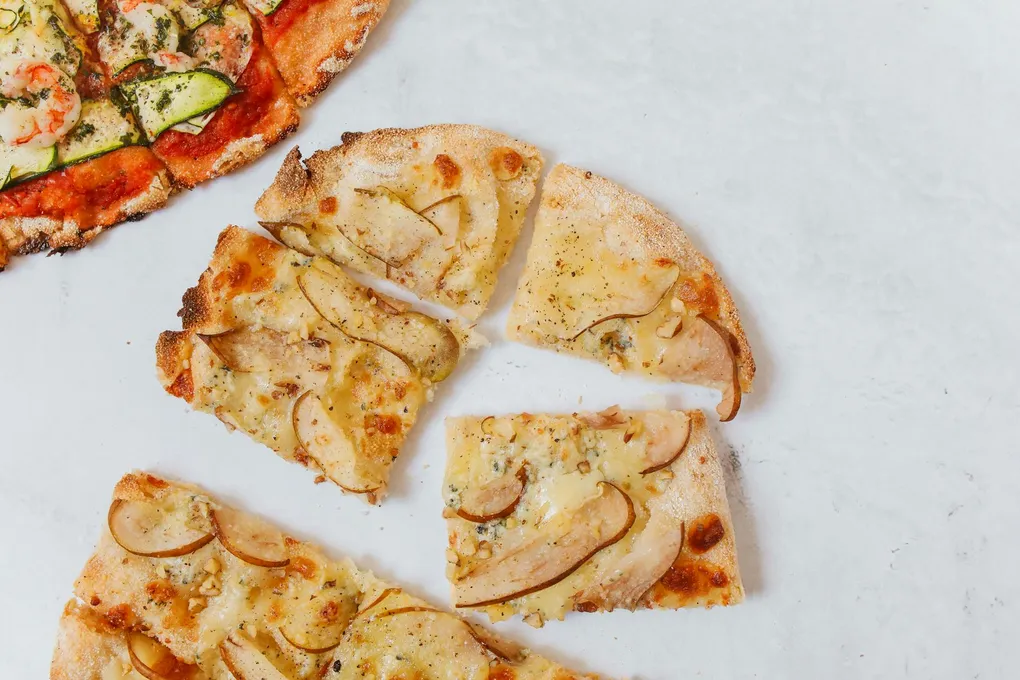
Assembly order is the most underestimated variable in home pizza making. Two pizzas with identical dough, identical ingredients, and identical oven settings can taste noticeably different based solely on the order those ingredients were placed on the dough. The reasons are physical: moisture management, browning exposure, structural integrity, and heat transfer all change depending on what sits on top of what.
This is not about aesthetics. It is about how heat, moisture, and gravity interact during a 90-second to 15-minute bake.
Why Order Matters: Three Principles
1. Moisture Management
Every topping releases or retains moisture differently during baking. Wet toppings (fresh tomato sauce, fresh mozzarella, raw vegetables) release steam. That steam has to go somewhere. If it goes downward into the dough, you get a soggy base. If it goes upward into the oven air, the dough stays crispy.
The placement of wet ingredients determines which direction that moisture travels.
Sauce directly on dough creates a steam zone at the sauce-dough interface. Myhrvold identified this as the source of the “gel layer” — that white, gummy line of undercooked starch between crust and sauce. His team tested 120 pizzas and found the sauce-dough interface creates a condensation zone where rising steam cools, preventing the underlying dough from fully cooking.
Cheese between sauce and dough acts as a moisture barrier. The cheese layer intercepts moisture from the sauce, directing it upward. This is why cheese-down styles (Detroit, deep-dish, Grandma, NJ tomato pie) consistently produce crispier bases than sauce-down styles.
2. Browning Exposure
Toppings exposed to direct oven heat (positioned on top) will brown, char, and develop Maillard flavors. Toppings buried under other layers will steam rather than brown.
Pepperoni on top of cheese: cups, crisps, and renders fat that pools in the cup and fries the meat. Pepperoni under cheese: steams flat, stays soft, contributes moisture to the cheese layer.
Cheese on top: browns, blisters, develops toasted flavors. Cheese under sauce (Detroit/deep-dish): stays white, melts completely, creates superior stretch and pull.
This is a flavor choice, not a right-or-wrong question. But it should be an intentional choice.
3. Structural Integrity
Toppings are heavy. A fully loaded 12-inch pizza with sauce, cheese, and three toppings adds 200-400g of weight to a dough disk that might weigh only 250-370g. How that weight is distributed affects whether the center sags, whether the crust can support slices, and whether toppings slide.
Gemignani’s counterintuitive principle: use less cheese in the center, more toward the edges. During baking, cheese melts and flows inward. If you start with even coverage, you end up with a lake of cheese in the middle and bare edges. Starting with less in the center and more at the periphery produces even coverage after the melt.
Gemignani’s Standard Assembly Order
Gemignani’s assembly sequence, refined through 13 world championship wins, is the most detailed published method:
Step 1: Sauce First
Apply sauce in a spiral from the center outward, stopping 3/4 inch from the edge. This 3/4-inch border is the “sauce line” — it defines where the cornicione begins. Sauce beyond this line means no puff in the rim, because wet dough does not rise.
Less is more. In Neapolitan baking at 900F, the pizza is in the oven for 60-90 seconds. Every gram of sauce adds moisture that the bake must evaporate. In a home oven at 550F with a 7-8 minute bake, more sauce is tolerable because the longer bake drives off more moisture. But even at home, most people use too much sauce.
Step 2: Cheese (Center Outward, Less in Middle)
Distribute cheese from center outward, deliberately placing less in the center and more near the edges. Cheese melts, pools, and flows toward the lowest point (the center). By starting with asymmetric distribution, you end with even coverage.
For styles using shredded low-moisture mozzarella (NY, bar pizza), apply in a single even-ish layer. For styles using sliced or torn fresh mozzarella (Neapolitan), distribute in pieces with gaps between them — they will spread during baking.
Step 3: Other Toppings
Add toppings on top of cheese. Scatter evenly but do not overload. Gemignani’s Commandment #6: “Thou shalt not overtop thy pizza.” In a fast oven (60-90 seconds), dense vegetables like raw broccoli or thick pepper rings will not cook. Pre-cook anything that needs more than a few minutes of heat.
Step 4: Finishing Ingredients AFTER Baking
This is Gemignani’s Commandment #9: “Thou shalt slice before adding finishing ingredients.” Garlic oil, grated Parmesan, dried oregano, fresh herbs, arugula, prosciutto, and ricotta cream all go on after the pizza comes out of the oven and after it has been sliced.
Why after slicing? Toppings placed before slicing get dragged by the pizza wheel. Arugula gets cut and bruised. Prosciutto gets displaced. Finishing after slicing means each slice gets its own clean portion.
Fresh basil specifically should never go in the oven. At temperatures above 350F, the volatile oils that give basil its flavor flash off in seconds. Basil added before baking turns black, wilted, and flavorless. Added after baking, it stays vibrant and aromatic.
Style-Specific Build Sequences
Neapolitan
The simplest build. Fewer toppings, better quality, fast oven.
Margherita (the canonical order):
- Sauce: 60-80g crushed San Marzano, spread thin. You should see dough through the sauce.
- Fior di latte mozzarella: torn into pieces, distributed with gaps. In a home oven, add cheese 4 minutes into a 7-minute bake (Forkish’s technique) so the cheese does not overcook during the longer bake.
- EVOO: drizzle lightly
- After baking: fresh basil leaves, another light drizzle of EVOO
Marinara:
- Sauce: crushed San Marzano
- Garlic: sliced thin, placed on sauce
- Dried oregano: pinch scattered
- EVOO: drizzle
- No cheese at all
AVPN specifies 70-100g tomato without mozzarella, 60-80g with mozzarella. Oil: 4-5g. These are modest quantities. Neapolitan pizza is deliberately restrained.
New York
More substantial build. Cheese to the edge. Structure to support the fold.
Classic NY slice:
- Sauce: NY-NJ tomato sauce (thicker than Neapolitan, with tomato paste for body). Spread to within 1/4 inch of edge — NY pizza has minimal exposed crust.
- Grated hard cheese: light dusting of pecorino or Parmesan on the sauce
- Low-moisture mozzarella: shredded, edge-to-edge coverage. This is the structural cheese that holds soft texture long after baking.
- Toppings (if any): on top of cheese
- After baking: optional oregano, garlic powder, red pepper flakes, grated Parmesan
Gemignani’s “New Yorker” (cheese-down competition winner):
- Sliced dry mozzarella directly on dough (cheese-down)
- Sauce on top of cheese
- Pepperoni + fennel sausage + Calabrese sausage + roasted garlic + garlic oil on top
- After baking: piped ricotta dollops, dust Parmesan and oregano
The cheese-down approach in the “New Yorker” is not traditional for NY pizza but won the International Pizza Challenge. The cheese layer protects the dough from sauce moisture, producing a crisper base.
Detroit
The most prescribed build order of any style. Every step has a structural reason.
Classic Detroit Red Top:
- Dough pressed into oiled pan, proofed
- Parbake 5-6 minutes at 550F (sets structure)
- Pepperoni: laid on the parbaked crust
- Brick cheese (or substitute blend): cubed, distributed edge-to-edge. Cheese must touch all four pan walls. This is non-negotiable — the cheese-to-wall contact creates the frico crust.
- Second bake: 7 minutes at 550F, optional 1-2 minute broiler finish
- Sauce: spooned in “racing stripes” (2-3 lengthwise lines) ON TOP of the baked pizza, after it comes out of the oven
Why racing stripes on top? The sauce never touches the dough during baking, completely eliminating the gel layer problem. The warm sauce on the hot cheese creates a visual and textural contrast — tangy sauce, melted cheese, crispy frico edge, airy bread crumb, all in one bite. This is the Detroit sequence, and deviating from it produces a different (worse) pizza.
Frico crust formation (5-step mechanism):
- Cheese pushed to edges, touching pan walls on all sides
- Butterfat melts, pools at cheese-pan interface
- Fat fries the exposed dough edge
- Cheese caramelizes against hot pan wall
- During parbake, dough shrinks ~1/8 inch from edges — more cheese fills the gap, building a taller frico wall
Deep Dish (Chicago)
The inverted build. Cheese first, sauce last.
Gemignani’s deep-dish method:
- Dough pressed into deep (2”) buttered steel pan. Rest 30 minutes.
- Sliced part-skim mozzarella: layered on dough as a “liner” between crust and filling
- Cooked meats (if using): on top of mozzarella liner. Cooked meats go below so rendered fat flavors the layers above without soaking the crust.
- Raw sausage: pinched into flat nickel-size pieces on top of cooked meats. It cooks fully during the 29-minute bake.
- Provolone slices: layered over meats
- Vegetables (if using): on top of provolone
- Shredded mozzarella: added during last 2 minutes of baking only (keeps it from overcooking during the long bake)
- Sauce: added AFTER removing from oven. Warmed sauce, not cooked, poured on top. This keeps the sauce bright and fresh rather than caramelized and dull.
- After baking: piped ricotta cream (if using), never baked
The deep-dish build is engineering. The mozzarella liner prevents the crust from getting soggy. The meat layering puts rendered fat above the crust rather than soaking into it. The sauce-after-baking preserves brightness. Every placement has a moisture or structural rationale.
Sicilian / Grandma
American Sicilian (parbake method):
- Parbake dough 14 minutes at 450F (no toppings)
- Sauce
- Mozzarella (push cheese to pan edges for frico effect if desired)
- Toppings
- Second bake 13 minutes at 450F
Grandma (cheese-down):
- Sliced mozzarella directly on oiled dough
- Sauce dollops ON TOP of cheese
- Bake 12-15 minutes at 500F
- After baking: drizzle EVOO, fresh basil, grated Parmesan
The Cheese-Down Argument
Myhrvold makes a broad case for cheese-down, sauce-on-top assembly across styles: “A viable idea for most types of pizza.” His reasoning:
- Less soggy dough. Cheese barrier intercepts sauce moisture.
- Better cheese pull. Cheese melted directly against dough forms stronger bonds than cheese floating on sauce.
- Superior browning. Sauce exposed to direct radiant heat concentrates and caramelizes slightly.
- Reduced gel layer. The cheese layer insulates the dough-sauce interface.
Cheese-down is already standard in Detroit, deep-dish, NJ tomato pie, and at acclaimed Italian pizzerias like Pepe in Grani. It works. The only argument against it is tradition — and tradition varies by region anyway.
Common Assembly Mistakes
Too much sauce. The number one home pizza failure. Sauce is heavy, wet, and insulates the dough from oven heat. In a 60-90 second Neapolitan bake, excessive sauce means a raw, soggy center. In a 7-minute home oven bake, it means a gel layer and floppy slices. You should be able to see dough through Neapolitan sauce. NY sauce should coat, not pool.
Cold sauce on dough. Gemignani’s Commandment #4. Cold sauce drops the dough temperature, creating uneven baking. Pull sauce from the fridge when you pull dough — both need to reach room temperature.
Cheese past the sauce line. Cheese that extends beyond the sauce into the cornicione zone prevents the rim from puffing. That bare dough edge is supposed to be dry, so steam can expand the gas bubbles inside. Cheese seals it.
Wet toppings without drainage. Fresh mozzarella, fresh tomatoes, and roasted vegetables all release water. Slice fresh mozzarella the night before and drain in a colander in the fridge. Pat roasted vegetables dry. If using fresh tomato slices, remove the seeds and gel.
Overtopping. In a fast oven (60-90 seconds), dense toppings will not cook through. In any oven, excessive toppings weigh down the center, prevent heat penetration, and create a heavy, soggy pizza. Use roughly half the toppings you think you want.
The 10-Second Window
The most impactful and least discussed moment in pizza making is the 10 seconds after the pizza exits the oven. This is when finishing ingredients go on — and the thermal energy from the hot pizza activates aromatics in a way that oven heat destroys.
- EVOO drizzle: Heat activates volatile compounds in good olive oil. The same oil baked into pizza loses these aromatics (they evaporate). Drizzled on hot pizza, they bloom.
- Flaky salt (Maldon): Dissolves partially on the hot surface, creating bursts of salinity. Very different from salt dissolved into the dough.
- Fresh basil: Placed on the hot pizza, it wilts just slightly — releasing aromatics without destroying them.
- Shaved Parmigiano: Melts on contact with the hot surface. Curls. Releases the nutty, umami flavor that grated-and-baked Parmesan loses.
- Honey drizzle: For spicy pies. The contrast of sweet honey, spicy pepperoni or nduja, and salty cheese is one of the most compelling flavor combinations in modern pizza.
Gemignani is emphatic: these additions go on after slicing, not before. The pizza wheel drags toppings, displaces arugula, and smears delicate finishes. Slice first. Finish each slice individually.