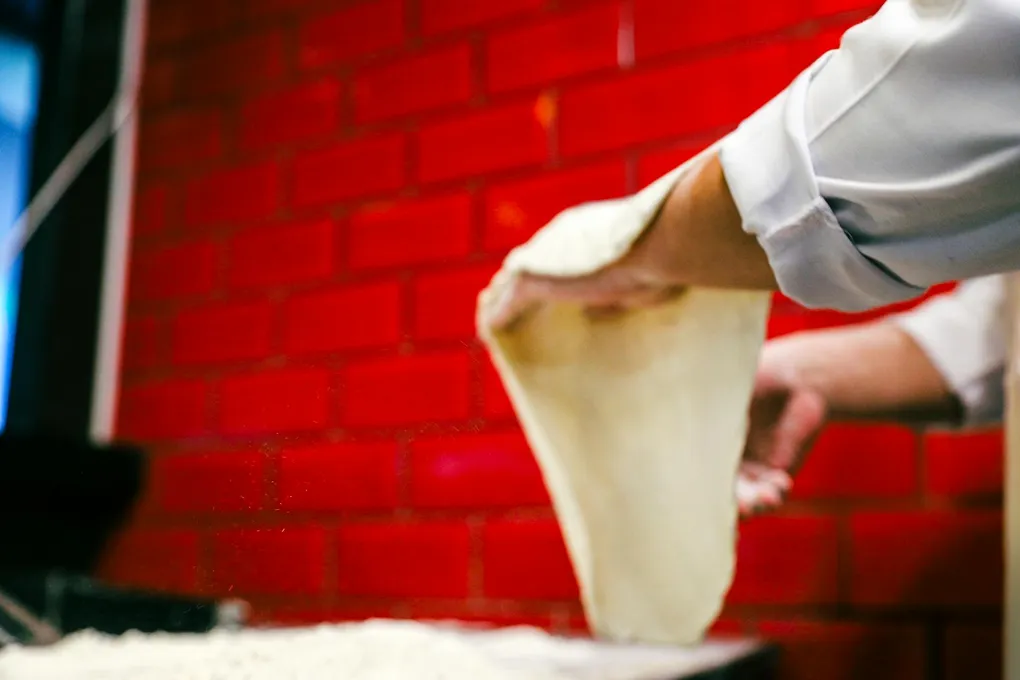
Every pizza technique — mixing, kneading, resting, fermenting, stretching — is either building, maintaining, or deliberately weakening the gluten network. Understanding what gluten actually is and how it behaves gives you control over every stage of the process, from a shaggy mass of flour and water to a stretched disk ready for the oven.
What Gluten Is (Molecularly)
Gluten isn’t a single substance. It’s a network formed by two families of proteins that exist separately in dry flour and only interconnect when water is added.
Glutenin is the polymeric (chain-forming) protein. Its molecules are large, with high molecular weight, and they connect to each other through disulphide bridges — covalent sulfur-to-sulfur bonds (S-S) that are the strongest bonds in the dough network. Glutenin controls tenacity: the dough’s resistance to deformation. When you pull dough and it resists, that’s glutenin.
Gliadin is the monomeric (single-unit) protein. It interacts with the gluten network only through weaker non-covalent bonds — hydrogen bonds, hydrophobic interactions. Gliadin controls extensibility: the dough’s ability to stretch and flow without snapping back. When dough yields to your pull and stretches smoothly, that’s gliadin.
The balance between these two proteins — captured in Italian flour science as the P/L ratio (tenacity/extensibility, measured by an alveograph) — determines whether your dough cooperates or fights you. A P/L below 0.40 produces sticky, slack dough. Above 0.70 produces rigid, unworkable dough. The Neapolitan TSG standard specifies 0.50-0.70.
The critical insight from Masi: It’s not total protein percentage that matters most — it’s the molecular weight distribution (MWD) of the proteins. A flour with 12% protein could have a W value (strength index) anywhere from 200 to 320 depending on the proportions and sizes of its glutenin and gliadin molecules. This is why W number is a better predictor of dough behavior than protein percentage, and why Italian bakers have a significant advantage: their flour bags routinely print the W value.
How Water Builds the Network
Dry flour contains glutenin and gliadin as separate, inactive proteins. Nothing happens until water arrives.
Water does two things simultaneously:
-
Hydrates the proteins. Water molecules insert themselves between glutenin and gliadin strands, allowing them to unfold, extend, and physically interconnect. Gliadin dissolves in the water phase and becomes mobile enough to find glutenin chains and attach via non-covalent bonds.
-
Enables enzymatic activity. Proteases (protein-cutting enzymes naturally present in flour) activate in the presence of water and begin slowly cleaving gluten proteins. This enzymatic action is slow at first but becomes the dominant force during long fermentation.
The moment flour and water combine, gluten formation begins passively — even without any mechanical input. This is the principle behind autolyse.
Autolyse: Letting Time Replace Effort
Autolyse is the technique of mixing only flour and water, then resting for 20-60 minutes before adding salt, yeast, or pre-ferments. The concept was developed by French baking professor Raymond Calvel in the mid-1970s.
During autolyse, five things happen:
- Flour more completely absorbs water (full hydration)
- Amylase enzymes begin breaking complex carbohydrates into simple sugars
- Protease enzymes begin degrading gluten proteins, increasing extensibility
- Reduced oxidation preserves flavor (no mechanical aeration)
- Better gas retention and volume in the finished product
The practical result: dough that has autolysed for 30 minutes requires significantly less kneading. The gluten network has already partially formed through passive hydration.
Forkish’s position: He uses autolyse for his FWSY pizza doughs but considers it unnecessary for his Elements of Pizza recipes. The reasoning: at lower hydration with tiny yeast amounts, the slow fermentation itself creates a natural autolyse effect over hours. The flour has plenty of time to hydrate without a dedicated rest.
Gemignani’s position: He recommends a 30-minute presoak (flour + water only) and extends it up to 6-8 hours when working ahead. His concern is practical: enzymatic action during the presoak gives the mixer less work to do.
Caveat: If yeast is included in the autolyse, limit it to roughly 20 minutes. Without salt to regulate it, yeast reproduces rapidly and can over-ferment the dough before you’ve even started.
Mechanical Energy: Mixing and Kneading
Mixing and kneading add mechanical energy that accelerates gluten network formation. Physical stretching and folding forces glutenin chains to align, extend, and form new disulphide bridges. It’s the fastest way to build structure.
But for pizza, less is more.
Forkish’s principle: Hand mixing is preferred for most pizza doughs. It produces a more delicate crust — ethereal, weightless, crisp. Less gluten organization means less chewiness. Machine mixing (stand mixer, lowest speed, roughly 90 seconds) is reserved for stiff doughs below 65% hydration (like New York at 64%), where hand mixing can’t develop the network efficiently.
Masi identifies three mixing outcomes:
- Developed (optimal): Correct gluten network, proper covalent bonds
- Underdeveloped: Insufficient mixing, stringy texture, sticky
- Overmixed: Gluten network formed then destroyed by continued mechanical action. Dough becomes flaccid, sticky, and yellow-tinged. Excessive heat from friction converts bonds prematurely.
The danger zone for pizza is over-mixing. Bread wants maximum gluten development for volume. Pizza wants controlled development for delicacy. Forkish: “Elastic is not a happy word in the pizza maker’s lexicon.”
The Windowpane Test
The windowpane test is the standard method for evaluating gluten development. Pinch off a small piece of dough and stretch it gently between your fingers. If it stretches thin enough to become translucent without tearing — thin enough to see light through it — the gluten network is sufficiently developed.
For pizza, you don’t necessarily need to pass the windowpane test. That level of development is ideal for bread but can indicate over-development for pizza. A dough that stretches smoothly without tearing but isn’t quite translucent is usually right for Neapolitan and other soft-crust styles. For New York, which needs more structure, getting closer to a full windowpane is appropriate.
How Fermentation Weakens Gluten (and Why That’s Good)
Here’s where pizza dough science diverges most dramatically from bread science.
In bread, you want to build the strongest possible gluten network because you need maximum gas retention for volume. In pizza, you want to build the network and then partially dismantle it through fermentation, because extensibility (the ability to stretch without snapping back) matters more than volume.
During fermentation, three enzymatic processes gradually weaken the gluten network:
Protease enzymes cleave peptide bonds in gluten proteins, breaking large glutenin polymers into smaller fragments. This directly reduces tenacity and increases extensibility. The longer the fermentation, the more protease activity, the more extensible the dough becomes.
Organic acids (lactic and acetic) produced by fermentation lower the dough’s pH. At lower pH, the ionic interactions between gluten proteins change — some bonds weaken, allowing the network to relax.
Ethanol produced by yeast also has a relaxing effect on gluten, lubricating the protein strands and allowing them to slide past each other more easily.
This is the fundamental reason cold fermentation produces better pizza: at 4C, yeast drops to roughly 10% activity while enzymes retain 40-50% activity. The enzymes are 4-5x more active relative to yeast than at room temperature. You get extensive protease action (extensibility) without excessive CO2 production (over-proofing).
Maturation vs. fermentation (Masi’s distinction): Fermentation is yeast producing CO2 and expanding the dough. Maturation is enzymatic processes splitting complex structures into simpler elements. A properly matured dough is extensible and stretches without tearing. An insufficiently matured dough springs back. An over-matured dough tears and develops holes. The target is maturation that matches fermentation — both reaching their peak at the same time.
Iacopelli’s Three Gluten Structures from One Dough
One of the most actionable demonstrations of gluten management comes from Iacopelli. Using the exact same 70% hydration recipe (1000g flour, 700ml water, poolish, 25g salt), he produced three completely different crumb structures by varying only one thing: how long the dough rested before being divided into balls.
| Method | Rest Before Balling | Crumb Result | Best For |
|---|---|---|---|
| STG Classic | None — ball immediately | Dense, small regular cells, chewy | Traditional Neapolitan |
| Alveolated | 20 min covered rest | Balanced, larger pockets, soft + crunchy | Best all-around home pizza |
| Sponge Texture | 20 min rest, reball, 20 min rest, ball | Ultra-light, very large irregular holes | Maximum airiness |
Zero extra ingredients. The only variable is time. A 20-minute wait transforms the crust because the gluten network has time to relax and redistribute stress before being locked into its final shape.
Flour Choice and Gluten Quality
Higher protein flour makes a stronger gluten network, but the type of protein matters as much as the quantity.
Hard wheat (American bread flour): Higher proportion of high-molecular-weight glutenin. Creates strong, elastic networks. Best for styles that need structure: New York, bar pizza, pan pizza.
Soft wheat (Italian 00): Different glutenin-to-gliadin balance. More extensible, less elastic. Creates tender, delicate networks. Best for Neapolitan and Roman styles where softness is the goal.
The W-number gap for American bakers: W number measures the total energy a dough bubble absorbs before bursting (alveograph test). It’s the single best predictor of how a flour will perform in pizza dough. But American flour bags almost never print it. American bakers must use protein percentage as a rough proxy, knowing the correlation is imperfect — a 12% protein flour can have W from 200-320 depending on wheat variety and milling.
Rough W-to-protein mapping for hard wheat:
- W 180-220: 10-11.5% protein (all-purpose range)
- W 220-260: 11.5-12.5% protein (Italian 00 Pizzeria equivalent)
- W 260-300: 12.5-13% protein (strong AP, light bread flour)
- W 300-350: 13-14% protein (bread flour)
- W 350-400+: 14-15%+ protein (high-gluten flour)
Practical Gluten Management: A Summary
| Stage | What’s Happening to Gluten | Your Goal |
|---|---|---|
| Flour + water | Proteins hydrate, network begins forming | Full, even hydration |
| Autolyse (optional) | Passive development, protease begins | Reduce later mixing needs |
| Mixing/kneading | Mechanical energy aligns and connects proteins | Develop structure WITHOUT over-building |
| Bulk ferment | Protease weakens network, acids relax bonds | Convert elasticity to extensibility |
| Ball ferment | Continued enzymatic action in shaped dough | Reach optimal maturation |
| Tempering | Gluten warms and relaxes at room temp | Dough yields to stretching |
| Stretching | Gluten extends to final shape | Smooth stretch without tearing |
| Baking | Proteins denature and cross-link permanently at 65-97C | Structure locks in place |
Every step either builds or loosens the gluten network. Good pizza happens when you build enough network to hold gas and support toppings, then loosen it enough to stretch easily and produce a tender, light crust. The balance point varies by style — more structure for New York, less for Neapolitan — but the principle is universal.
Understanding gluten doesn’t just make you a better pizza maker. It makes every confusing recipe instruction — why autolyse, why cold ferment, why 00 for Neapolitan, why bread flour for New York, why rest before stretching — suddenly make mechanical, molecular sense.