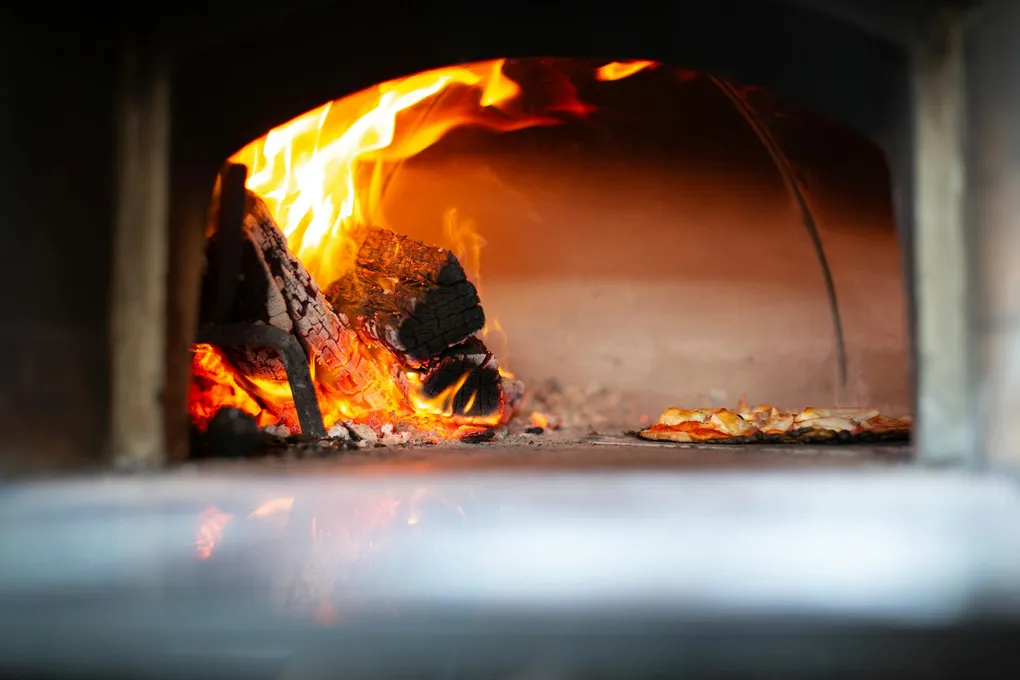
The single most common reason home pizza disappoints is temperature. Not the wrong recipe, not the wrong flour, not bad technique — insufficient heat. Your oven says 500F. Your pizza steel says something different. And the gap between what you think is happening and what is actually happening inside your oven explains most of the problems you are having.
Why Your Oven Is Lying to You
When your home oven beeps to signal it has reached 550F, it is telling you that the air has reached that temperature. The air heats in about 21 seconds. But the oven walls, the baking surface, and the thermal mass that actually bakes your pizza take much, much longer.
Myhrvold’s research in Modernist Pizza demonstrated this with thermal measurements: at 22 minutes after the “ready” signal, significant cold spots remain on the baking surface. The oven walls are still absorbing heat. The steel or stone you are baking on has not equilibrated.
Minimum preheat time with a baking steel or stone: 45-60 minutes at maximum temperature. Not from the time you turn the oven on — from the time it reaches its set temperature. Gemignani goes further: he preheats his two-stone home setup at 500F for a full hour before baking.
This is the most impactful change most home pizza makers can make. It costs nothing. It just requires patience.
Optimal Temperatures by Style
Every pizza style has a target temperature range, and the physics behind each range are different.
| Style | Professional Oven | Home Oven Target | Bake Time (Home) | Surface |
|---|---|---|---|---|
| Neapolitan | 905F (485C), wood-fired | 550F + broiler finish | ~7 min | Steel or stone |
| New York | ~550F, gas deck | 550F | ~7 min | Steel or stone |
| Roman dinner | Wood-fired, very hot | 550F | ~7 min | Steel or stone |
| Roman al taglio | 520-595F, electric deck | 550F | Varies | Sheet pan, finish on steel |
| Pan pizza | N/A | 500-550F | 12-15 min | Sheet pan on steel |
| Bar pizza | N/A | 550F | 8-10 min | Deep-dish pan on steel |
| Detroit | 480-525F, pizza deck | 500-550F | 12-15 min (parbake + finish) | Blue steel pan |
The key pattern: hearth-baked styles (Neapolitan, NY, Roman) need maximum temperature. Pan styles work at slightly lower temperatures because the pan mediates heat transfer and the longer bake time is a feature, not a bug.
The Temperature-Texture Continuum
Forkish articulates a crucial relationship that most home bakers overlook:
| Oven Temp | Bake Time | Result |
|---|---|---|
| 500F (260C) | Longer | Crisper crust, less moisture retained |
| 700F (371C) | ~2.5-3 min | Softer, more moist, closer to Neapolitan |
| 900F (482C) | ~90 seconds | True Neapolitan — maximum moisture retained |
This is not just “hotter = faster.” It is a fundamentally different pizza. A 90-second bake at 900F retains so much moisture in the dough that the crust is soft, pliant, and floppy — classic Neapolitan character. A 7-minute bake at 550F drives off far more moisture, producing a crisper, drier crust even with the same dough.
This is why hydration must match oven temperature. Using AVPN 58% hydration dough in a 550F home oven produces a cardboard-like crust. Using 70% hydration dough in a 900F oven creates an unmanageable wet center. Forkish’s recipes account for this: his home oven formulas run at 70% hydration specifically to compensate for the extended bake time.
Why Home Ovens Cannot Replicate Wood-Fired Results
The gap between a home oven and a wood-fired pizza oven is not just temperature — it is the physics of heat transfer.
Masi’s research identifies three heat transfer mechanisms in pizza baking:
- Conduction (from the baking floor): Heat transfers by direct contact. This is what your steel or stone provides.
- Radiation (from the oven dome/ceiling): This follows the Stefan-Boltzmann T-to-the-fourth power law. A dome at 450C (842F) radiates 16 times more energy than a surface at 200C (392F). This is the dominant heat source in a wood-fired oven and the one home ovens cannot replicate.
- Convection (hot air currents): The least significant of the three in pizza baking.
A wood-fired oven has a massive refractory brick dome at 450-470C radiating enormous energy downward onto the pizza top. A home oven has a thin sheet metal ceiling that radiates comparatively little. The broiler element is the only way to add meaningful top heat in a home oven, which is why every serious home pizza method involves the broiler.
Three Proven Home Oven Methods
1. Steel + Broiler (Forkish Method)
This is the most commonly recommended approach and the one Forkish uses in both The Elements of Pizza and Flour Water Salt Yeast.
- Place baking steel on upper rack, 6-8 inches below the broiler element.
- Preheat oven to maximum (500-550F) for 45-60 minutes.
- Switch to broiler on high.
- Launch pizza onto steel.
- Bake 7-8 minutes, rotating once halfway through.
The FWSY variation is more specific: preheat to max for 30 minutes, switch to broil for 5 minutes to superheat the surface, switch back to bake at 525F, load the pizza, bake 5 minutes, then switch to broil for the final 2-3 minutes while watching closely.
Total bake time: 7-8 minutes at 525F, or 4-5 minutes at 600F. The broiler provides the top heat that the oven cannot generate through radiation alone.
2. Skillet-Broiler (Lopez-Alt Method)
Kenji Lopez-Alt’s approach from Serious Eats uses stovetop-to-oven transfer:
- Preheat cast iron skillet on stovetop for 3 minutes over high heat.
- Shape 10-inch dough, top, and transfer to the hot skillet.
- Slide under broiler for 90 seconds to 4 minutes (rotate after 45 seconds).
- Return to stovetop for 30 seconds to 2 minutes to char the bottom.
This produces what Lopez-Alt describes as “baby leopard spots, bubbles starting to char, the puff of a cornicione.” The direct stovetop contact creates bottom heat that steel-on-rack cannot match, while the broiler handles the top. The limitation is pizza size (10 inches, constrained by skillet diameter).
3. Two-Stage Bake (Iacopelli Method)
Iacopelli’s approach is the most forgiving for home bakers and addresses the biggest home oven problem: cheese burning before the crust finishes.
- Steel on top rack. Preheat at broil/max for 30-40 minutes, then switch to static bake at max (250C/482F).
- First bake: Sauce and olive oil only (no cheese). Bake until crust is golden and puffed.
- Remove. Brush olive oil on crust edges. Add mozzarella and other toppings.
- Second bake: Return to oven until cheese melts and bubbles.
- Total: 7 minutes maximum.
The two-stage approach ensures the crust has time to develop structure and color before cheese is added. In a single-stage bake at 550F, the cheese can overcook and separate before the crust underneath is fully baked. The two-stage method eliminates this timing conflict.
4. Two-Stone Rotation (Gemignani Method)
Gemignani calls this his “favorite discovery for home pizza”:
- Place one stone/steel on the upper third rack and another on the bottom rack.
- Preheat at 500F for one full hour. Non-negotiable.
- Start pizza on the top surface. Bake 6 minutes.
- Lift onto a peel, rotate 180 degrees, transfer to the bottom surface. Bake 5 more minutes.
- Total: approximately 11 minutes.
The logic: the bottom surface has not been cooled by contact with dough. It is a fresh hot surface. Any time the bottom needs more crisping, move the pizza to the unused surface.
Between pizzas: brush surfaces clean with a dry heatproof brush. Do not use water or a damp towel on hot stones — thermal shock risk.
The Broiler Hack Every Home Baker Should Know
The most advanced home oven technique combines preheating at a lower temperature with aggressive broiler use:
- Steel on top rack, 7 inches from broiler element.
- Preheat at 450F convection for 1 hour.
- Switch to broiler 5 minutes before launch. The steel surface exceeds 500F.
- Launch pizza. Broil for 90-120 seconds — you will see massive oven spring.
- Switch back to convection. Rotate 180 degrees.
- Bake 2-5 more minutes.
Electric oven tip: Preheat at 450F (below the thermostat limit), then switch to broil. Because the oven reads the air as “cool” relative to the broil setting, the heating element fires immediately and stays on, delivering maximum radiant heat. At higher preheat temperatures, the thermal sensor may cycle the broiler off before the pizza is done.
Cold Dough Is an Emergency
Gemignani’s Fifth Commandment: “Thou shalt not put cold dough in a hot oven.”
Cold dough straight from the refrigerator creates large, uneven bubbles in the first 2-3 minutes of baking. The outside of the dough heats quickly while the cold interior expands unevenly. The result: a pizza with blown-out bubbles on one side and a dense, undercooked center.
Allow dough balls to warm to 60-65F before baking. This takes 1-2 hours at room temperature depending on ball size — see how long to proof pizza dough for the full timing framework. Gemignani recommends checking with an instant-read thermometer.
Iacopelli’s guidance is more relaxed: pull dough from the fridge 20 minutes before baking. The difference reflects their different fermentation and dough ball sizes, but the principle is universal — some tempering is essential.
What an Infrared Thermometer Tells You That Your Oven Cannot
The single most useful piece of equipment for home oven pizza, after the baking surface itself, is an infrared (IR) thermometer. They cost $25-50.
Your oven’s built-in thermometer reads air temperature. An IR thermometer reads surface temperature — and surface temperature is what actually bakes the base of your pizza.
Check the center of your baking surface before every pizza. The surface should be within 5C (9F) of your target. Common findings:
- The center of the steel reads 50-75F lower than the oven’s air temperature after only 30 minutes of preheating. This is why you need a full hour.
- After removing a pizza, the contact area reads 50-100F lower than the rest of the surface. This is why recovery time between pizzas matters.
- One side of the surface is consistently cooler than the other (near the door, far from the heating element). This is why rotating the pizza is necessary.
Emissivity matters for steel. An IR thermometer calibrated for stone (emissivity ~0.9) will give inaccurate readings on a seasoned steel surface (emissivity ~0.3-0.5). If your thermometer has adjustable emissivity, set it to match your surface. If not, understand that steel readings may be lower than actual temperature.
Preheat Protocol Summary
| Step | Home Oven | Portable Oven |
|---|---|---|
| Surface placement | Upper rack, 6-8” below broiler | N/A (built-in) |
| Preheat temp | Maximum (500-550F) | Maximum |
| Preheat duration | 45-60 min minimum | 30-40 min (not manufacturer’s claimed 15-20) |
| Pre-launch | Switch to broil 5 min before launching | Reduce to low flame before launching |
| Verify with IR | Center within 9F of target | Center stone at 750F+ |
| Door-opening compensation | Preheat 25F above target | Crank flame to high between pizzas |
The 7-Minute Rule
Iacopelli sets a hard maximum: 7 minutes total bake time in a home oven. Beyond that, the pizza becomes dry and hard rather than soft and crunchy. If your pizza is not done in 7 minutes, the problem is not bake time — it is that your oven was not hot enough, your surface was not preheated long enough, or your pizza was overtopped with moisture-heavy ingredients.
Reducing the problem to temperature rather than time is the fundamental shift in thinking that separates good home pizza from mediocre home pizza. Get the heat right and the timing takes care of itself.
Sources: Myhrvold & Migoya, Modernist Pizza Vol 1 (2021); Forkish, The Elements of Pizza (2016); Forkish, Flour Water Salt Yeast (2012); Gemignani, The Pizza Bible (2014); Masi et al., The Neapolitan Pizza: A Scientific Guide (2015); Iacopelli, YouTube (2019-2023); Lopez-Alt, Serious Eats.