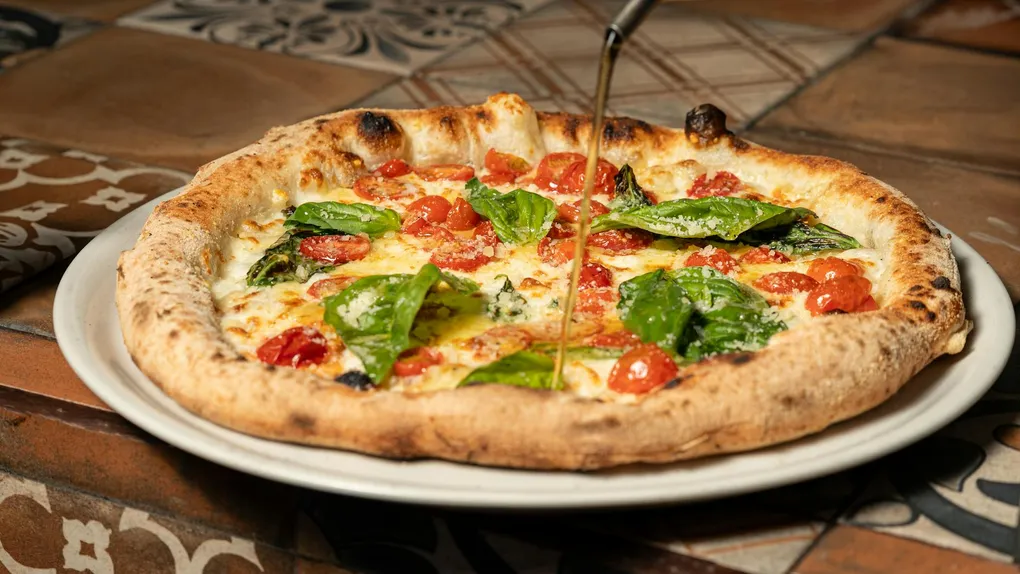
The most impactful and least discussed moment in pizza making is the 10 seconds after the pizza exits the oven.
Most home bakers spend hours on dough, obsess over oven temperature, debate flour brands — then pull the pizza out and cut it immediately. That is like spending all day braising short ribs and skipping the seasoning at the end. The finishing step is where a good pizza becomes a memorable one.
Why Post-Bake Finishing Matters
The science here is straightforward. During baking, your pizza undergoes extreme heat — 500F to 900F depending on your setup. At those temperatures:
- Volatile aromatic compounds evaporate. The delicate, complex flavors in high-quality olive oil, fresh herbs, and finishing salts either flash off entirely or break down. EVOO baked at pizza temperatures loses a significant portion of its best qualities. [Masi pp. 94-95]
- Fresh ingredients wilt or burn. Basil turns black. Arugula disintegrates. Prosciutto dries to jerky.
- Salt dissolves and distributes. Fine salt sprinkled before baking dissolves into the sauce and cheese, losing its textural impact entirely.
Finishing after the oven reverses all of these problems. You are adding flavor at the exact moment when the residual heat of the pizza can activate aromatic compounds without destroying them.
EVOO: The Essential Finishing Oil
Extra virgin olive oil is the single most important post-bake addition across virtually all pizza traditions. But the way it interacts with your pizza changes dramatically depending on when you add it.
What Happens to EVOO During Baking
Masi’s laboratory analysis provides the clearest picture of EVOO under pizza oven conditions:
- During a 60-90 second Neapolitan bake at 380-400C, EVOO loses approximately 30% of its phenolic compounds — the antioxidants, bitterness, and complexity that distinguish good olive oil from generic.
- The baking time is too short to reach EVOO’s smoke point (210-220C), so no harmful compounds (acrylamide) form. The oil is safe to bake with.
- During baking, bitter phenols migrate to the liquid phase. Complex phenols hydrolyze in the acidic tomato environment, losing their bitter character. Only a fraction of the fruity aroma of fresh oil survives.
- Conclusion: “Nutritionally more appropriate to add EVOO after baking” to maximize bioactive components. [Masi pp. 94-95]
In a home oven baking for 7-8 minutes at 500-550F, the phenolic losses are even greater — the longer bake gives more time for volatiles to evaporate and compounds to break down.
What Happens When You Drizzle EVOO After Baking
The pizza surface exits the oven at roughly 200-350F depending on the area (cheese surface, exposed crust, sauce). When you drizzle oil onto this hot surface:
- The oil heats quickly but not to the point of smoke or degradation.
- The warmth activates volatile aromatic compounds — the fruity, grassy, peppery notes of good EVOO bloom into the air and coat your palate.
- The oil does not have time to break down because you are eating the pizza within minutes.
- Visually, the oil creates an attractive sheen on the surface and pools slightly in depressions, concentrating flavor.
This is why every serious pizzeria finishes with oil. It is not decorative. It is a functional flavor delivery mechanism.
Which EVOO to Use
Not all olive oil is worth finishing with. For baking (in the dough or on the pizza before it goes in), cheap pure olive oil is fine — the heat eliminates any quality advantage of premium oil. For finishing, quality matters enormously because you are tasting the oil directly.
Gemignani recommends Filippo Berio or Corto — both fruity without being excessively grassy or peppery. His preference reflects a principle worth adopting: your finishing oil should complement the pizza, not compete with it. An aggressive, pungent EVOO that is wonderful on bread can overwhelm the more delicate flavors of mozzarella and tomato. [Gemignani, Theory]
Look for:
- Harvest date on the label (not just “best by” — olive oil degrades with age)
- Single-origin or estate oil rather than blends
- Fruity and medium-peppery profiles for pizza — save the powerfully bitter Tuscan oils for bruschetta
- Dark glass bottles or tins — light degrades olive oil rapidly
A good rule: if you would not enjoy a spoonful of the oil on its own, do not put it on your finished pizza.
Flaky Salt: Texture and Flavor in One Move
Fine sea salt dissolved into dough during mixing is essential — it builds flavor into the crust structure and controls fermentation. But fine salt added to a finished pizza disappears instantly. It dissolves into the moisture of the sauce and cheese, contributing salinity but zero textural interest.
Flaky finishing salt — Maldon being the most widely recognized brand — behaves completely differently:
- The large, irregular crystals sit on the surface and do not dissolve immediately.
- When you bite into a flake, it delivers a concentrated burst of salinity against the backdrop of the milder-seasoned crust and cheese.
- The crunch of the crystal adds a textural dimension that complements the softer textures of melted cheese and sauce.
- Because the salt is concentrated in discrete spots rather than evenly distributed, the flavor experience varies with each bite — some bites saltier, some milder, creating contrast.
Gemignani lists Maldon sea salt flakes specifically as a finishing salt for pizza. [Gemignani, Theory]
How to Apply
- Timing: Within 30 seconds of pulling the pizza from the oven, before cutting.
- Method: Pinch flakes between thumb and forefinger, hold 12-18 inches above the pizza, and let them fall. The height ensures even distribution. Do not dump from a container — you will over-salt one area.
- Amount: Less than you think. Start with 2-3 pinches across the entire pizza. You can always add more after the first slice; you cannot remove it.
- Where it works best: On any pizza with mozzarella as the primary cheese. The salt contrasts beautifully with the mild, milky cheese. Particularly effective on Margherita, white pies, and any pizza with burrata or ricotta.
Fresh Basil: After, Not During
This one is non-negotiable for Neapolitan and Margherita pizzas: fresh basil goes on after the oven, not before.
The volatile oils that give basil its aroma — linalool, eugenol, estragole — flash off rapidly above 350F. Basil leaves placed on pizza before a 500-900F bake will turn black, lose all aroma, and contribute a bitter, papery taste rather than the bright, sweet, slightly anise-like flavor you are looking for.
Place whole leaves (not chopped — chopping releases and wastes aromatics) on the pizza immediately after it exits the oven. The residual heat is enough to gently wilt the leaves, releasing their oils at the perfect intensity.
This principle applies broadly to fresh delicate herbs: basil, fresh oregano leaves, mint, chervil, and cilantro all go on after. Dried oregano is the exception — it needs heat to bloom its flavors and should go in the sauce or on the pizza before baking.
The Complete Post-Bake Playbook
Gemignani codifies this as Commandment #9: “Thou shalt slice before adding finishing ingredients.” The reasoning: if you finish and then cut, the knife drags your carefully placed toppings across the pizza. If you cut first and then finish, each slice gets its own precise garnish. For fresh-topped pizzas (prosciutto, arugula, shaved cheese), slice first, then top each wedge individually — this preserves height, even distribution, and presentation. [Gemignani, Master Class]
Here is the full post-bake sequence for a well-finished pizza:
Step 1: Rest (15-30 seconds)
Transfer the pizza to a cooling rack or cutting board. A brief rest allows the cheese to set slightly, making cleaner cuts. A cooling rack prevents the bottom from steaming and losing its crispness.
Step 2: Cut
Slice into your desired pattern — wedges for round, squares for tavern or pan style.
Step 3: Drizzle EVOO
A thin stream in a zigzag pattern across all slices. Not a flood — 1-2 teaspoons for a 12-inch pizza.
Step 4: Flaky Salt
2-3 pinches from height, distributed evenly.
Step 5: Fresh Herbs
Whole basil leaves, torn if large. Distribute across slices.
Step 6: Shaved or Grated Hard Cheese
Parmigiano-Reggiano or Pecorino Romano, shaved with a vegetable peeler or microplaned. The heat of the pizza softens the cheese just enough that it begins to melt at the edges while retaining its crystalline texture in the center.
Step 7: Specialty Finishes (style-dependent)
These go last because they are the most temperature-sensitive or texturally delicate:
| Finishing | Best On | Notes |
|---|---|---|
| Arugula | Margherita, prosciutto pies, white pizza | Dressed lightly with lemon juice and EVOO before placing |
| Prosciutto di Parma | Margherita, fig, burrata pies | Drape on after cutting — heat curls and wilts it gently |
| Hot honey | Spicy soppressata, pepperoni, four-cheese | The sweet-heat-salt combination is one of the best flavor triangles in pizza |
| Burrata | Margherita, arugula pies | Cut open and place torn pieces. Never bake burrata. |
| Ricotta cream | NY-style, Sicilian, deep-dish | Gemignani: pipe from pastry bag after baking — baked ricotta is heavy and weeps |
| Balsamic glaze | Fig and prosciutto, caprese-style | A few drops only — balsamic is potent |
| Chili oil or chili flakes | Most styles | Red pepper flakes before baking work too, but finishing chili oil preserves the bright, fruity heat |
| Lemon zest | White pizza, clam pizza, seafood | Microplane directly over the pizza for maximum volatile release |
Roman Al Taglio: The Post-Bake Tradition
The Roman al taglio tradition is the most fully developed post-bake topping culture in pizza. In the Bonci style of al taglio (named for Gabriele Bonci of Pizzarium), the crust is prebaked at night, then topped cold before service. This means every element on a Bonci-style pizza is either raw or room temperature, added to a warm crust. The result is a style where the “finishing” IS the topping. [Myhrvold pp. 140-142]
Even in the more traditional Iezzi-style al taglio (toppings baked on), the custom is to finish with brushstrokes of olive oil after baking and sometimes freshly grated cheese (pecorino, caciocavallo) right as the pizza exits the oven. [Forkish Ch2]
Roman pomodoro pizza — crust baked with only tomato sauce and olive oil — gets its cheese (pecorino or caciocavallo, grated) entirely after baking. The heat of the crust softens the cheese without melting it into an undifferentiated mass.
Common Mistakes
Finishing before cutting. Gemignani’s Commandment #9 exists for a reason. Cut first, finish second.
Using EVOO in the dough and expecting olive oil flavor. EVOO loses its distinguishing characteristics when mixed into dough and baked. If you want olive oil flavor in your finished pizza, save the good stuff for finishing and use cheaper pure olive oil (or any neutral oil) in the dough. Myhrvold confirms: EVOO and cheap olive oil are “functionally equivalent” when incorporated into dough. [Myhrvold p. 354]
Over-finishing. The point of finishing is precision, not volume. A drizzle of oil, a few flakes of salt, a few leaves of basil. More is not better — more turns your pizza into a salad on bread.
Waiting too long. The residual heat of the pizza is what activates your finishing ingredients. Once the pizza cools below about 150F, the EVOO will not bloom, the cheese will not soften, and the basil will not wilt. Finish fast.
Finishing with cold ingredients on hot pizza when texture matters. Cold arugula on hot pizza is fine — you want the contrast. But cold ricotta cream on hot pizza creates a jarring temperature mismatch where the cream hits your palate noticeably colder than everything around it. Gemignani specifies bringing ricotta cream to room temperature before piping.
The Minimum Viable Finish
If you take nothing else from this article, adopt this three-second habit: every pizza, every time, gets a drizzle of good EVOO and a pinch of flaky salt within 10 seconds of leaving the oven.
That alone will elevate your pizza more than any dough tweak, flour upgrade, or oven modification. It is the simplest, cheapest, most impactful improvement available to any home pizza maker.
Sources: Masi, Romano & Coccia, The Neapolitan Pizza: A Scientific Guide (2015); Gemignani, The Pizza Bible (2014); Forkish, The Elements of Pizza (2016); Myhrvold & Migoya, Modernist Pizza Vol 1 (2021).