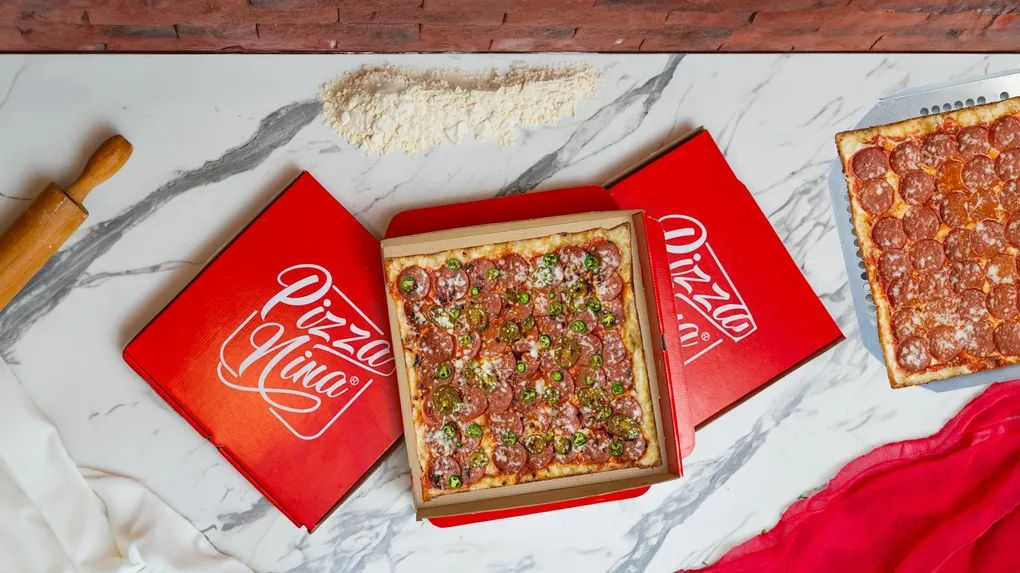
Detroit-style pizza is defined by three things that happen at the edges of the pan: cheese touching metal, fat pooling at the interface, and the resulting crust that’s half frico, half fried bread. Everything else — the airy, focaccia-like interior, the sauce racing stripes on top, the thick layer of toppings — exists in service of that edge.
Getting it right at home requires understanding why each element works and how they interact. This isn’t a recipe to freestyle. The pan matters. The cheese matters. The order of operations matters. Here’s the full picture.
The Pan: Blue Steel and Its Modern Substitute
Detroit-style pizza originated in 1946 at Buddy’s Rendezvous in Detroit, where the first pies were baked in blue steel automotive parts trays — the drip pans used to catch oil and grease in factories. These rectangular steel pans conducted heat aggressively and evenly, creating the crisp bottom and caramelized cheese edge that became the style’s signature.
You can’t walk into a kitchen supply store and buy those original trays. The modern equivalent is a LloydPans 10x14” hard-anodized aluminum pan with Tuff-Kote non-stick coating. These arrive pre-seasoned and are purpose-built for Detroit-style pizza. They’re not optional — the pan geometry, material, and non-stick surface are all load-bearing for the technique.
Why the specific pan matters:
- Rectangular shape (10x14”): Defines the style. Round pans make pan pizza, not Detroit.
- Hard-anodized aluminum: High thermal conductivity heats the dough evenly and aggressively from the bottom. Darker anodization absorbs more radiant heat.
- Straight 2-inch walls: The cheese needs vertical surfaces to caramelize against. Sloped sides defeat the frico mechanism.
- Non-stick coating: Essential. Melted cheese and rendered butterfat will bond permanently to uncoated steel or aluminum. You need to extract the finished pizza cleanly.
Seasoned blue steel pans from Detroit pizza supply companies (like the ones Detroit-style restaurants use) are available online but expensive and require maintenance — they rust without proper oiling and storage. For home bakers, LloydPans is the practical answer.
The Dough: High Hydration, Fermented in the Pan
Detroit dough is closer to focaccia than to Neapolitan. It’s wet, it’s oily, and it rises in the pan rather than on a board. The target hydration is 70-75%, which produces the open, airy crumb structure with large irregular holes that defines the style.
The Formula
| Ingredient | Amount | Baker’s % |
|---|---|---|
| Bread flour (13-14% protein) | 350g | 100% |
| Water (90°F) | 255g | 73% |
| Fine sea salt | 10g | 2.9% |
| Instant dry yeast | 3.5g | 1.0% |
Yield: enough for one 10x14” LloydPans Detroit pizza.
Myhrvold’s testing found the optimal Detroit hydration at approximately 75%, with plus or minus 5% yielding “well-balanced comparable pizzas.” At 70%, the crumb is slightly tighter. At 80%, you’re fighting the dough during the pan push-out. The 73% target above splits the difference.
Flour choice matters: Myhrvold recommends a blend of 85% bread flour + 15% semolina for Detroit. Gemignani uses his 13-14% protein Master Dough. Either way, you need strong flour — the high hydration and long fermentation demand a robust gluten network. Italian 00 flour (designed for 60-second bakes) will produce a weak, collapsed crumb.
The Method
Day 1:
- Dissolve yeast in the warm water. Add flour and salt. Mix until shaggy — 2-3 minutes by hand or 90 seconds on low with a dough hook. The dough will be wet and sticky. That’s correct.
- Cover. Rest 15-20 minutes.
- Brief knead or stretch-and-fold in the bowl: reach under, pull up, fold over. Rotate 90 degrees, repeat 4 times. The dough should smooth out noticeably.
- Cover and bulk ferment 1-2 hours at room temperature until visibly puffed (roughly 50% increase).
- Grease the LloydPans pan generously — 2-3 tablespoons of olive oil or a combination of olive oil and butter.
- Transfer dough to the pan. With oiled fingertips, press and spread toward the edges. The dough will resist and spring back. That’s normal. Press it as far as it will go comfortably, then cover and rest 20-30 minutes. Come back and push again. Two to three rounds of press-and-rest will get the dough to the corners without tearing.
- Cover tightly with plastic wrap and refrigerate 24-48 hours.
Day 2 (Bake Day):
- Remove pan from fridge. Let it sit at room temperature for 2-3 hours. The dough should be visibly puffy and fill the pan to the edges.
- If the dough has pulled away from the corners during cold ferment, gently press it back with oiled fingertips.
- The dough is now ready for toppings and baking.
Gemignani’s approach is slightly different: he uses his Master Dough without starter (65% hydration, lower than pure Detroit formulas), parbakes the crust for 6 minutes at 500°F before adding cheese and toppings, and finishes with his two-stone transfer method. The parbake step is worth considering — it sets the bottom crust and prevents the gel layer (the white gummy line between crust and sauce that Myhrvold identifies as “a fundamental flaw in pizza making”).
The Cheese: Brick Cheese and the Frico Mechanism
This is the part that makes or breaks a Detroit pizza. The cheese isn’t just a topping — it’s a structural element that creates the caramelized crust edge that defines the style.
Wisconsin Brick Cheese is the traditional choice. It’s a semi-soft American original derived from white cheddar with higher butterfat content than mozzarella. That high fat content is the key: the butterfat withstands oven heat, melts evenly, and pools at the edges to fry the dough.
The Frico Formation Mechanism (5 Steps)
Understanding this process is the difference between mediocre pan pizza with cheese on it and actual Detroit-style pizza:
-
Cheese pushed to edges, touching pan walls on all sides. This is non-negotiable. You’re not just distributing cheese on top of dough — you’re pressing cubed cheese against the vertical walls of the pan.
-
Butterfat melts and pools at the cheese-pan interface. As the cheese heats up, rendered fat runs downward and collects where cheese meets metal. This fat is about to do the real work.
-
Fat fries the exposed dough edge. The pooled butterfat heats to frying temperature against the hot pan wall. The dough edge, now submerged in hot fat, crisps and browns — not from dry oven heat, but from actual frying.
-
Cheese caramelizes against the hot pan wall. The milk solids in the cheese, in direct contact with 500°F+ metal, undergo both Maillard browning and caramelization. This produces the dark, lacquered, almost-burnt-but-not-quite cheese crust.
-
Parbaking causes dough to shrink approximately 1/8” from edges — more cheese fills the gap, building taller frico. If you parbake (Gemignani’s method), the dough pulls slightly inward as it sets. When you add cheese for the final bake, it flows into that gap, creating an even thicker cheese wall.
Cheese Application
Cut the cheese into roughly 1/2-inch cubes — not shredded, not sliced. Cubed cheese melts more slowly and evenly, creating a better fat-rendering pattern.
Distribute cubes evenly across the entire surface of the dough, edge to edge. Then deliberately push additional cubes against the pan walls on all four sides. You want cheese physically touching every inch of the pan’s vertical surface.
How much cheese: For a 10x14” pan, plan on 350-450g (12-16 oz) of cheese. This feels like a lot. It is a lot. That’s the style.
The Brick Cheese Problem (and the Solution)
Most people outside Wisconsin and Michigan have never seen brick cheese in a grocery store. The standard substitute blend:
- 2/3 low-moisture mozzarella (cubed, not shredded)
- 1/3 white cheddar (cubed)
Stack the white cheddar cubes specifically against the pan edges — the higher butterfat in cheddar drives more aggressive frico formation against the walls. The mozzarella handles the interior coverage.
Some Detroit pizza makers add a small amount of Monterey Jack to the blend for additional melt smoothness. Gemignani uses brick cheese plus white cheddar, with the cheddar stacked at the edges for maximum frico char.
The Build: Assembly Order
Detroit pizza has a specific, non-negotiable assembly order that differs from every other pizza style:
- Dough (in the pan, proofed and at room temp)
- Pepperoni (or other toppings, placed directly on the dough — under the cheese)
- Cheese (cubed, edge-to-edge, touching all four walls)
- Bake
- Sauce (racing stripes, applied after the pizza comes out of the oven)
The cheese-on-top-of-toppings configuration is what protects the toppings from direct heat while the cheese above them renders fat, melts, and forms the frico edge. The toppings steam gently under a blanket of melting cheese.
The sauce goes on last — after baking. This is the “racing stripes” technique: two or three lengthwise lines of warm sauce applied to the finished pizza. Sauce on top of baked cheese means the tomato stays bright, acidic, and fresh — it’s a flavor contrast to the rich cheese and fried crust, not a cooked-in element.
The Sauce
Detroit sauce is cooked (unlike most pizza sauces). The style uses a thick, seasoned tomato sauce with pronounced garlic and oregano:
- 28 oz crushed San Marzano tomatoes
- 4 cloves garlic, minced
- 2 tablespoons olive oil
- 2 teaspoons dried oregano
- 1 teaspoon onion powder
- 1/2 teaspoon red pepper flakes
- 1 tablespoon sugar
- Salt to taste
Saute garlic in olive oil, add everything else, simmer 30 minutes, blend smooth. Warm before applying to the finished pizza.
Gemignani’s version: 360g ground tomatoes + 125g tomato paste + EVOO + salt + oregano, pureed with an immersion blender and warmed before serving.
The Bake
Oven Setup
Position your rack in the lower third of the oven. Detroit pizza needs aggressive bottom heat for the frico to form — the pan needs to be closer to the heat source.
If you have a baking steel, place it on the rack and put the Detroit pan directly on the steel. The steel’s thermal mass drives faster, more even heat into the pan bottom.
Preheat to 500-550°F for at least 30 minutes with the steel in place.
Baking Protocol
Without parbake (simpler):
- Build the pizza (toppings, then cheese, edge-to-edge)
- Bake at 550°F for 12-15 minutes until cheese is bubbly across the surface and the edges show deep golden-brown to dark brown frico
- Optional: 1-2 minutes under the broiler to finish the top
With parbake (Gemignani method — better frico):
- Parbake the dough alone for 5-6 minutes at 500°F
- Remove, add pepperoni, then cheese (edge-to-edge, cheddar against walls)
- Return to oven for 7-9 minutes at 500°F
- The parbake creates a set crust that won’t develop a gel layer and allows more aggressive frico formation
How to Know It’s Done
- Cheese across the surface is fully melted and bubbling, with some browning
- Edges are dark golden-brown to nearly black at the cheese-pan junction — this is the frico, not burning
- The pizza has pulled slightly away from the pan walls (if you can see this gap, the frico has formed)
- Bottom of the crust (check by lifting a corner with a thin spatula) is deep golden-brown
Extraction
Let the pizza rest in the pan for 2-3 minutes after pulling from the oven. This lets the frico firm up slightly, making extraction cleaner.
Run a thin metal spatula or bench scraper along all four edges. Slide it under a corner and lift the entire pizza onto a cutting board. If you used a properly non-stick LloydPans pan, this should come out cleanly.
Apply warm sauce in racing stripes. Cut into squares (not wedges). Finish with grated Pecorino Romano, dried oregano, and a drizzle of garlic oil if desired.
Troubleshooting Detroit Pizza
| Problem | Cause | Fix |
|---|---|---|
| No frico / soft cheese edges | Cheese didn’t touch pan walls | Push cubes deliberately against all four walls |
| Gummy layer between crust and cheese | Moisture trapped in center | Parbake dough first, or use less sauce |
| Dough too dense / tight crumb | Hydration too low or under-proofed | Target 70-75% hydration; ensure 2-3 hour room temp proof after cold ferment |
| Bottom burns before cheese melts | Oven too hot at bottom, or too close to heat | Move rack up one position; reduce temp to 475°F |
| Dough won’t reach pan corners | Gluten too tight, needs more rest | Press-and-rest in 20-minute intervals; don’t force it |
| Cheese puddles but doesn’t frico | Wrong cheese — too much moisture | Use low-moisture mozzarella and cheddar, cubed not shredded |
Why Detroit Is Great for Home Bakers
This is one of the most forgiving pizza styles to make at home:
- No peel, no launch, no stuck-dough disasters. You build and bake in the same pan.
- No stretching skill required. The dough relaxes into the pan over time — you press, not stretch.
- Home oven temperatures (500-550°F) are ideal. Detroit doesn’t need 900°F. It needs 12-15 minutes of moderate high heat for the frico to develop, which is exactly what a home oven provides.
- Cold fermentation is natural. The ferment-in-pan approach means you prep one day and bake the next with minimal day-of work.
- The margin for error is wide. Myhrvold’s testing showed that Detroit dough at plus or minus 5% hydration still produced “well-balanced comparable pizzas.” It’s hard to ruin this.
The investment: a LloydPans Detroit pan (about $25-30) and some brick cheese or its substitute blend. Everything else you already own.