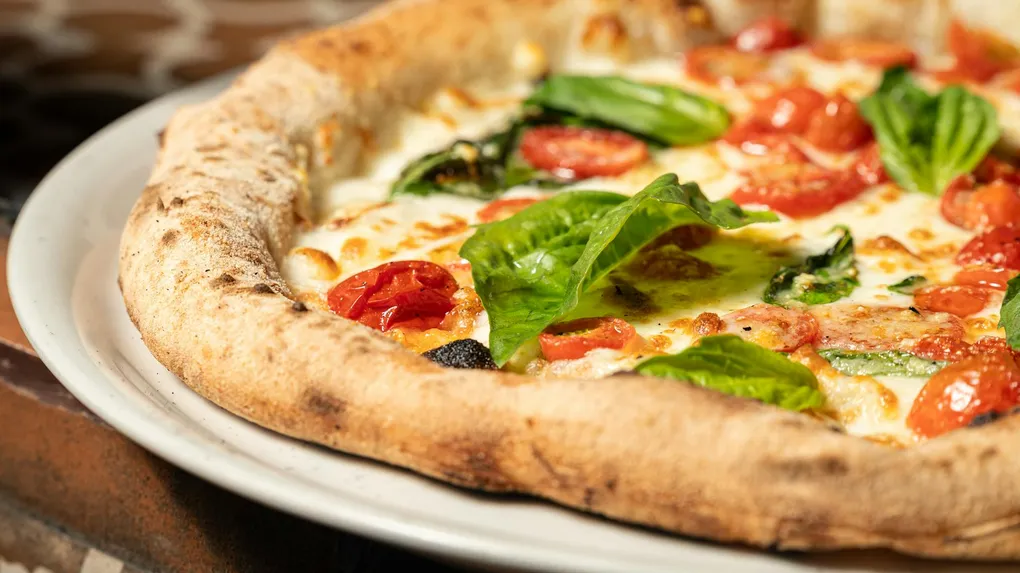
The cornicione — the raised rim of a pizza — is the single most visible indicator of how well a pizza was made. A great cornicione is puffy, airy, charred with leopard spots, and structurally sound enough to hold its shape when you pick up a slice. A flat, pale, dense rim tells you something went wrong with fermentation, shaping, or baking — usually all three.
Getting it right involves understanding where the gas comes from, how to preserve it during shaping, and what happens in the first seconds of baking that determines whether the rim puffs up or stays flat.
Where Cornicione Gas Comes From
During fermentation, yeast produces CO2 that gets trapped in the gluten network as tiny bubbles. By the time a properly fermented dough ball is ready to use, it contains thousands of these gas pockets distributed throughout its volume. The goal during shaping is to push the gas from the center of the dough outward into the rim while keeping those bubbles intact.
This is the key insight most home bakers miss: the cornicione isn’t created during baking. It’s created during shaping. Baking simply inflates what’s already there.
Masi’s Neapolitan TSG specification is precise about the finished dimensions: the center should be no more than 0.4 cm thick, and the rim should be 1–2 cm wide. That ratio — thin center, thick rim — is achieved entirely through how you handle the dough.
Shaping: Press the Center, Never Touch the Edge
Every authoritative source agrees on the fundamental technique, though they describe it differently.
Gemignani’s method: Press the dough starting 3/4 inch from the outer edge, working all the way around. Leave that outer ring completely untouched. “Leave the middle alone — the middle takes care of itself.” Only work the area between center and cornicione edge, stretching it thinner while pushing air toward the rim. The untouched rim accumulates all the gas that’s being displaced from the center.
Iacopelli’s method: Both palms flat and slightly cupped, fingers together, thumbs lifted. Press the center of the dough in small circular motions outward. “No stretch, just press” — pushing air toward the edges. Leave approximately 1 inch (2.5 cm) of rim untouched. Then flip and repeat on the other side.
Forkish’s method: Fingertip pressing from center outward, draping over knuckles for gravity stretch. Same principle — the rim stays untouched.
The common thread: the cornicione is defined by what you don’t do to it. Every press, poke, or squeeze to the outer edge destroys gas pockets that won’t reinflate.
What Degassing the Edge Looks Like
If you’ve ever pressed or rolled the edge of your dough — even briefly — you’ve felt how the dough deflates under your fingers. Those bubbles are gone. In a professional wood-fired oven at 900°F, even a partially degassed rim can still get some puff from steam expansion. In a 550°F home oven with a 7-minute bake, a degassed rim stays flat. There isn’t enough thermal violence to inflate it from nothing.
Oven Spring: The Three Forces
When pizza hits a hot baking surface, three forces drive oven spring — the rapid expansion that puffs the cornicione in the first moments of baking:
1. Thermal yeast burst. Yeast cells produce a final burst of CO2 as they heat up, right before dying at approximately 50°C (122°F). This is their last contribution.
2. Gas expansion. Existing CO2 and nitrogen bubbles (trapped during mixing and fermentation) expand as they heat. The gas law is straightforward: hotter gas occupies more volume.
3. Steam expansion. This is the dominant force. Water in the dough converts to steam, and steam occupies approximately 1,600 times the volume of liquid water. In a properly hydrated, properly fermented dough hitting a screaming-hot surface, this expansion is explosive.
Myhrvold’s team measured this directly: a Neapolitan rim starts at approximately 5mm thick and finishes at 2.5 cm — a 5x expansion. This is overwhelmingly driven by steam, not CO2. Pizza oven spring is fundamentally different from bread oven spring, which relies more heavily on yeast-produced CO2.
The implication for home bakers: Higher oven temperature = more violent steam expansion = puffier cornicione. A 900°F oven produces qualitatively different oven spring than a 550°F oven because thermal radiation follows a T^4 power law — baking at 400°C produces 16 times more thermal radiation than baking at 200°C (Myhrvold). This is why puffiness correlates so strongly with oven temperature.
Why Higher Hydration Helps at Home
In a 60-second Neapolitan bake at 900°F, the dough retains most of its moisture. The bake finishes before much water escapes. That’s why AVPN-spec Neapolitan dough runs 55–59% hydration — there’s plenty of water for steam expansion even at low hydration.
In a 7-8 minute home oven bake at 550°F, significantly more moisture evaporates. By the time the rim reaches peak expansion temperature, some of the water that would have become steam has already left the dough. This is why Forkish pushes home oven Neapolitan dough to 70% hydration — the extra water compensates for greater moisture loss during the longer bake.
If your cornicione is consistently flat and dense in a home oven, bumping hydration by 3-5% can make a visible difference. More water = more steam potential = more puff.
Fermentation Timing and Puffiness
Under-fermented dough produces a dense, tight cornicione. The gluten network is still too organized, too elastic. Gas pockets are small and few. The dough fights stretching, and the rim doesn’t have enough trapped gas to expand dramatically during baking.
Over-fermented dough produces a flat cornicione for the opposite reason. The gluten network has degraded too far — it can’t hold the gas that the steam expansion produces. Bubbles form and immediately rupture. The rim inflates momentarily then collapses.
The maturation sweet spot — what Masi describes as “3/4 of maximum dough volume” — is where the dough has enough gas for oven spring and enough residual gluten strength to contain the expansion. The dough ball should feel soft and pliable, with visible small bubbles on the surface, and the bottom should show gassy holes when turned over. When poked, the indentation should slowly spring back — not snap back (under-fermented) and not stay indented (over-fermented).
Gemignani’s visual readiness cues align: the dough ball should have expanded about 25–50% from its initial size (not doubled), feel “full of air” and light when lifted. Iacopelli adds: if the ball has visibly collapsed or smells alcoholic, it’s past peak.
Leopard Spots: The Positive Feedback Loop
Leopard spots — the dark brown to black char marks on the rim — are one of the most visually appealing features of a well-baked pizza. Understanding how they form explains why they’re hard to replicate at lower temperatures.
Myhrvold identified the mechanism as a positive feedback loop driven by emissivity:
- Raw white dough has low emissivity (~0.1), meaning it reflects approximately 90% of incident thermal radiation.
- As a spot on the dough begins to darken through Maillard browning, its emissivity increases.
- Higher emissivity means that spot now absorbs more heat from the oven dome/broiler.
- Absorbing more heat makes it darken faster.
- Darkening further increases emissivity, which increases heat absorption, which accelerates darkening.
This feedback loop is self-amplifying. Once a spot starts darkening, it accelerates — which is why leopard spots tend to be distinct, concentrated marks rather than uniform gradual browning. The spots that darken first pull away from the pack.
Why this matters for temperature: The feedback loop only kicks in when there’s enough radiant heat to start the process. In a 900°F oven with intense dome radiation, the loop initiates quickly and produces dramatic spotting. In a 550°F home oven, radiant heat is dramatically weaker (remember T^4), and the loop either doesn’t start or runs slowly — producing gradual, uniform browning instead of distinct spots.
Bubbles and Burning
The feedback loop is most intense on large bubbles. When a bubble inflates in the cornicione, its top surface expands away from the moist dough underneath, drying out faster. Dry surface + elevated position (closer to heat source) + increasing emissivity = the fastest-darkening part of the pizza. In a professional Neapolitan oven, pizzaioli pop large bubbles as they form with a quick press of the turning peel — otherwise those spots go from leopard to carbon.
At home oven temperatures, this is less of a concern. The slower bake gives you more time, and bubbles rarely darken fast enough to burn before the pizza is done.
The Diastatic Malt Fix for Home Ovens
If your cornicione comes out pale and anemic despite good fermentation and proper shaping, the issue is likely insufficient Maillard browning at home oven temperatures. The Maillard reaction requires amino acids and reducing sugars, and it accelerates significantly above 280°F — but at 550°F, the reaction runs much slower than at 900°F. The pizza finishes baking before the crust has time to develop deep color.
Diastatic malt powder is the solution. It contains active enzymes that break down flour starches into maltose and other reducing sugars — the fuel for Maillard browning. More available sugar means the browning reaction starts earlier and runs further during your 7-8 minute bake window.
Gemignani uses 2% diastatic malt as a standard ingredient (not optional) in his Master Dough. Kenji Lopez-Alt’s NY-style formula also includes 2%. Myhrvold recommends 0.5–1% for home oven doughs.
The key word is diastatic — meaning the enzymes are still active. Non-diastatic malt powder is just a sweetener (the enzymes have been deactivated by heat). Diastatic malt is available at beer-brewing supply stores and some specialty baking suppliers.
Omit malt if baking above 650°F (in a portable oven, on a grill, or under a powerful broiler). At those temperatures, Maillard browning happens readily without assistance, and extra sugars can push browning into burning.
The Broiler: Your Home Oven’s Leoparding Tool
The single most effective home oven technique for cornicione browning and puffiness is the broiler finish. The broiler element produces intense radiant heat from above — mimicking (at much lower intensity) the dome radiation of a wood-fired oven.
Forkish’s protocol: Bake on a steel positioned 6–8 inches below the broiler. Start on bake at max temperature. In the final 2-3 minutes, switch to broil and watch the cornicione carefully. The direct radiant heat initiates the emissivity feedback loop on the rim bubbles, producing leopard-like spots that a bake-only approach cannot.
The broiler approach also produces faster oven spring because the top of the cornicione heats more aggressively, driving faster steam expansion in the surface layer. The result is a rim that puffs more dramatically than it would from convective oven heat alone.
Electric oven tip: Preheat at 450°F (below the thermostat cutoff), then switch to broil. The broiler coils fire immediately because the oven reads as “cold” relative to the broil setpoint. This gives you stronger, more sustained broiler output than switching to broil from a fully preheated oven, where the thermostat may cycle the element on and off.
Dough Temperature at Bake Time
Gemignani’s Fifth Commandment: “Thou shalt not put cold dough in a hot oven.”
Cold dough straight from the fridge produces oversized, irregular bubbles in the first 2-3 minutes of baking. The temperature differential causes uneven gas expansion — cold pockets next to rapidly heating surfaces create large, uncontrolled blisters that char on top while the rest of the rim stays pale. The cornicione looks uneven and amateurish.
The fix: temper dough balls to 60–65°F (15–18°C) before baking. This takes 1–2 hours on the counter depending on ambient temperature. Gemignani checks with an instant-read thermometer. Iacopelli suggests a minimum of 20 minutes out of the fridge.
Properly tempered dough expands more uniformly, producing the even-sized bubbles and consistent browning that characterize a professional cornicione.
The Complete Cornicione Checklist
- Fermentation: Dough balls at 3/4 maximum volume. Soft, pliable, slow spring-back when poked.
- Temperature: Dough tempered to 60–65°F. Not straight from the fridge.
- Shaping: Press from center outward. Never touch the outer 3/4 inch. Push gas into the rim, not out of it.
- Hydration: For home ovens (550°F), use 65–70%. Extra water compensates for moisture loss during the longer bake.
- Malt: 0.5–2% diastatic malt powder for home oven doughs. Omit above 650°F.
- Oven: Maximum temperature. Steel or stone preheated 45–60 minutes. Broiler finish for the last 2–3 minutes.
- Don’t overload: Heavy toppings in the center weigh down the transition zone between flat center and rim, preventing the cornicione from lifting. Keep toppings at least 3/4 inch from the edge.
Each step compounds. Nail all seven and the cornicione takes care of itself. Miss two or three and you’ll wonder why your rim looks like flatbread.