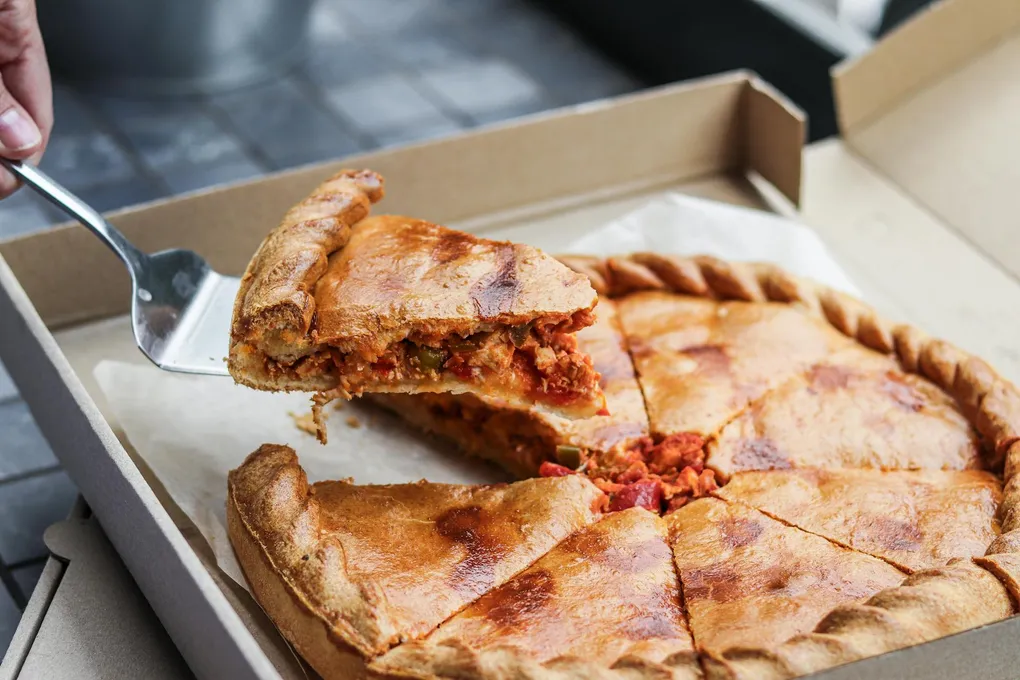
Ask someone from outside Chicago what Chicago pizza is, and they will describe deep dish. A thick, towering pie in a round pan, cheese on the bottom, chunky tomato sauce on top, weighing in at roughly eight pounds per pie. It is the pizza that defines Chicago to the rest of the world.
Ask a Chicagoan what they actually eat, and the answer is usually different.
The Sales Split Most People Do Not Know
Myhrvold’s research into Chicago pizza consumption reveals a number that surprises outsiders: downtown Chicago sells roughly 70% deep-dish and 30% thin-crust. That tracks with tourist traffic — visitors come for deep dish because that is what they have heard about. Move to the suburbs, however, and the ratio flips to roughly 50/50. In many neighborhood spots, thin cracker-crust tavern-style pizza is what goes out the door most often. [Myhrvold p. 265]
This is not a debate about which style is better. Both are legitimate Chicago traditions with distinct histories, dough formulations, and eating contexts. But if you want to understand Chicago pizza, you need to know both.
Chicago Deep Dish: Two Pizzas Under One Name
The first thing to understand about deep-dish pizza is that there are two fundamentally different crust types, and most people — including many Chicagoans — do not realize they are eating different things.
The Pie-Crust Style (Pizzeria Uno)
The original deep-dish pizza appeared at Pizzeria Uno in 1943. Traditional credit goes to Ike Sewell, the restaurateur, but the emerging historical evidence suggests the actual inventor was likely Alice Mae Redmond, an African American cook who worked in the kitchen. Redmond’s contribution has been increasingly recognized by food historians, though the attribution remains debated. [Myhrvold pp. 94-95]
The Uno-style deep-dish crust is:
- Yellow-hued — from corn elements (cornmeal, corn flour, or corn oil depending on the version)
- High fat — butter, lard, or both, making it closer to a pie crust or shortcrust pastry than bread dough
- Low salt — a characteristic flaw of Chicago pizza that Myhrvold notes extends to both deep-dish and thin-crust versions
- Pressed, not stretched — the dough is pushed into the pan like Play-Doh, not stretched by hand
Gemignani’s deep-dish formula reflects this tradition: all-purpose flour (Ceresota preferred, about 12% protein), approximately 63% hydration (60% in Gemignani’s summary chart, 63.3% in the actual recipe), medium-grind cornmeal at 4.9%, plus both lard (4.2%) and European-style unsalted butter (4.2%). The result is rich, flaky, and closer to savory pastry than pizza crust in the Italian sense. [Gemignani, Deep-Dish Dough]
The White-Bread Style (Burt Katz)
The second deep-dish tradition comes from Burt Katz, who operated several legendary Chicago pizzerias including Burt’s Place and Pequod’s. Anthony Bourdain called Katz’s pizza “the only deep-dish pizza I ever loved.” [Myhrvold p. 95]
The Katz-style crust is:
- White and pillowy — a bread-like dough without the corn element
- Bready texture — more like focaccia than pie crust
- Caramelized cheese edge — Katz pushed extra cheese around the pan edges, creating a frico-like crust where melted cheese fried against the hot pan wall
Where the Uno-style feels like eating a savory tart, the Katz-style feels like eating a bread bowl filled with cheese and sauce. They are different foods that happen to share the same name and the same city.
Deep-Dish Assembly
Both styles share an inverted assembly order that distinguishes deep-dish from nearly all other pizza:
- Crust pressed into a tall-sided (1.5-3 inch) round steel pan
- Cheese on the bottom — sliced mozzarella layered directly on the crust
- Fillings in the middle — sausage, peppers, onions, mushrooms
- Thick tomato sauce on top — the sauce forms a visible top layer, not a base layer
This inversion exists for a practical reason. A 25-35 minute bake would destroy mozzarella placed on top — it would brown, then burn, then become inedible long before the thick crust finishes. By burying the cheese under sauce, it melts and stays protected. [Myhrvold pp. 93-96]
Gemignani’s refined approach takes the assembly further: part-skim mozzarella sliced on the bottom as a “liner” between crust and filling, provolone in the middle, and shredded mozzarella added only for the final 2 minutes of baking. The sauce goes on warm — but after the pizza exits the oven, for brighter, fresher flavor. Cooked meats go below in the filling, raw sausage on top (its rendered fat flavors the layers below without soaking the crust). Ricotta cream is piped on after baking, not baked in. [Gemignani, Deep-Dish Method]
The Deep-Dish Design Flaw
Myhrvold identifies a fundamental structural problem with deep-dish pizza: the gel layer. This is the white, gummy, undercooked line of starch that forms between the crust and the wet sauce/filling above it. Myhrvold tested 120 pizzas to study this phenomenon. [Myhrvold pp. 400-402]
The mechanism: sauce creates a cool, wet surface where rising steam from the baking dough condenses. The dough at this interface never gets hot enough or dry enough to fully cook. The result is a band of gelatinized but incompletely baked starch.
The only complete fix is prebaking the dough before adding fillings — which is, as Myhrvold notes, “considered a no-no in Chicago.” Partial mitigations include placing cheese directly on the dough first (as Gemignani does), controlling sauce amounts, and adding sauce after baking. [Myhrvold pp. 400-402]
Chicago Tavern Style: The Pizza Chicagoans Actually Eat
Tavern-style pizza is the working-class pizza of Chicago — the pizza ordered at neighborhood bars, the pizza cut into squares and passed around tables, the pizza that feeds a crowd without ceremony.
Defining Characteristics
- Ultra-thin, cracker-like crust — flat, crisp, no poof, no rise, no cornicione
- Square cut (tavern cut) — 16 small squares, not triangular wedges
- Toppings to the very edge — no exposed crust border
- Cheese on top of sauce — standard order, unlike deep-dish
- Moderate amounts of everything — not piled high like deep-dish
The crust is the defining feature. Where Neapolitan aims for soft and foldable, New York for crisp but pliable, and deep-dish for thick and pie-like, tavern-style aims for cracker. You should hear it snap when you bite into it.
The Dough
Gemignani’s cracker-thin Chicago dough uses all-purpose flour (Ceresota, 12% protein), 65% hydration with a poolish starter, medium-grind cornmeal (5.3%), diastatic malt (2.3%), and notably no butter or lard — a key departure from the deep-dish formula. The starter provides flavor complexity without the fat enrichment that characterizes deep-dish. [Gemignani, Cracker-Thin Dough]
| Ingredient | Baker’s % |
|---|---|
| AP flour (Ceresota) | 100% |
| Total water | 65.1% |
| Cornmeal | 5.3% |
| Diastatic malt | 2.3% |
| Poolish | 20.9% |
| Salt | 2.3% |
| Active dry yeast | 0.5% |
The technique is distinctly non-artisanal:
- Roll the dough with a rolling pin — no hand stretching
- Roll slightly larger than target, then trim to size with a pizza wheel
- Press edges flat — deliberately eliminate any rim
- Dock aggressively — poke the entire surface with a fork or docking tool, especially the edges, to prevent any bubbling
- Bake sauce-only first for 3-4 minutes to set the crust before adding cheese and toppings
The sauce-only prebake is critical for achieving the cracker texture. Adding cheese from the start would insulate the top surface and trap moisture, preventing the crust from crisping fully.
The Cut
Tavern cut (also called party cut or pub cut) means cutting the round pizza into a grid of small squares. A 14-inch pizza yields roughly 16 pieces. This is not an accident of sloppiness — it is a deliberate serving strategy:
- Small pieces are easy to grab with one hand while holding a drink
- The center pieces have no crust edge — they are all topping
- The corner pieces have the most crust — textural variety in every pizza
- It feeds more people from a single pie than wedge cutting
- It is the cut of a shared table, not individual slices
Tavern-Style at Home
The home execution is straightforward because the dough is forgiving and the technique is simple:
Dough: Mix per Gemignani’s formula above. Cold ferment 24-48 hours.
Shaping: Roll to 14 inches on a floured surface. Trim edges to a clean circle. Dock the entire surface thoroughly. Transfer to a parchment-lined or cornmeal-dusted peel.
Baking: On a preheated steel at 500-550F, bake sauce-only for 3-4 minutes until the surface is set and beginning to dry. Remove, add cheese (low-moisture mozzarella, shredded) and toppings. Return and bake 5-7 more minutes until cheese is fully melted and edges are crisp.
Cutting: Let rest 2 minutes. Cut in a grid pattern for 16 square pieces.
The Deep-Dish Dough Formula
For home bakers who want to tackle the classic:
| Ingredient | Amount | Baker’s % |
|---|---|---|
| AP flour (Ceresota or similar, ~12% protein) | 430g | 100% |
| Ice water | 202g | 47.0% |
| Warm water (80-85F) for yeast | 70g | 16.3% |
| Total water | 272g | 63.3% |
| Medium-grind cornmeal | 21g | 4.9% |
| Diastatic malt | 9g | 2.1% |
| Fine sea salt | 9g | 2.1% |
| Lard (room temp) | 18g | 4.2% |
| European-style unsalted butter (room temp) | 18g | 4.2% |
| Active dry yeast | 4.5g | 1.0% |
Method: Stand mixer with dough hook. Knead 2-3 minutes. Rest 1 hour at room temperature. Refrigerate 24-48 hours. On bake day, roll to 17 inches, ease into a well-buttered 12-13 inch round pan with 2-inch walls, and rest 30 minutes. [Gemignani]
Bake: 500F, 15 minutes on bottom rack, rotate and bake 12 more minutes, add shredded mozzarella on top for final 2 minutes. Total approximately 29 minutes. Warm sauce ladled on top after removing from oven. Finish with piped ricotta, Pecorino Romano, and oregano.
Chronically Undersalted: A Chicago Problem
One of Myhrvold’s most interesting observations about Chicago pizza — both deep-dish and thin-crust — is that the dough is chronically undersalted. The sauce tends to be oversalted to compensate, creating an imbalanced flavor profile where the crust tastes flat and the sauce tastes sharp. [Myhrvold p. 265]
Gemignani’s deep-dish formula uses 2.1% salt, and his cracker-thin uses 2.3% — both on the lower end compared to his other doughs (Napoletana at 2.2%, Romana at 3.1%, Multigrain at 3.1%). This is consistent with the Chicago tradition but worth noting for home bakers: do not be afraid to push the salt in your crust to 2.5% if your finished pizza tastes unbalanced.
Two Pizzas, One City
Deep dish is Chicago’s ambassador to the world — dramatic, photogenic, and unmistakable. Tavern style is Chicago’s daily bread — unpretentious, shareable, and designed for a table of friends splitting a pie at a neighborhood bar.
If you are visiting Chicago, eat both. If you are cooking at home, start with tavern style. It is simpler, faster, more forgiving, and — if you have spent any time making other thin-crust pizzas — the skills transfer directly. The cracker-thin dough with a poolish starter, rolled flat, docked, and baked to a snap, is one of the most satisfying simple pizzas you can make.
Deep dish is a project. A wonderful, rewarding project — but a project. Plan a weekend for it.
Sources: Myhrvold & Migoya, Modernist Pizza Vol 1 (2021); Gemignani, The Pizza Bible (2014); Forkish, The Elements of Pizza (2016).