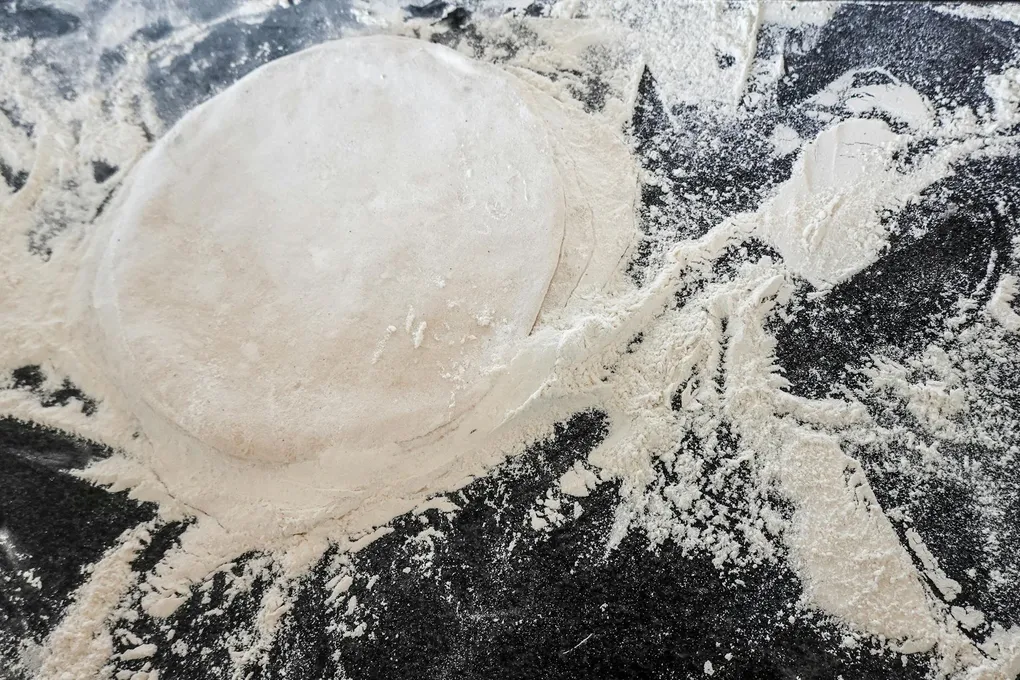
Flour is the foundation of every pizza dough, and choosing the wrong one for your style and oven is a mistake that no amount of technique can overcome. The problem: most flour advice online is either oversimplified (“just use 00 flour”) or so vague it is useless. The reality is that flour selection depends on the intersection of protein content, gluten strength, oven temperature, bake time, and fermentation duration.
Seven authoritative sources, cross-referenced, reveal a clear framework.
What Actually Matters in Flour
Four properties determine how a flour performs in pizza dough. Two are printed on American bags. Two are not.
Protein Content (%)
This is the number on the bag. Protein content roughly correlates with gluten strength — higher protein means a stronger gluten network, more elasticity, more chew, and more structure. But protein percentage alone does not tell the whole story.
- 10-12%: All-purpose flour. Adequate for short-fermentation doughs. Gemignani explicitly warns against it for pizza: “A lot of cookbooks will tell you that all-purpose flour is good for pizza making. For most pizzas, I disagree.” The exception: Chicago deep-dish and cracker-thin styles, where AP flour (specifically Ceresota or Heckers at ~12%) is traditional.
- 11-12.5%: Italian 00 pizza flour (Caputo Pizzeria, San Felice). The Neapolitan standard. Lower protein produces a more extensible, tender, less chewy crust.
- 12.5-13.5%: The versatile zone. Gemignani’s preferred range for his Master Dough. Enough structure for long ferments, enough tenderness for good eating.
- 13.5-14.5%: Bread flour and high-gluten flour. New York style territory. Produces the structure needed for a foldable slice that supports heavy toppings.
Gemignani provides a useful rule of thumb: 12.5-13% protein supports a 36-hour rise. 13-14% protein supports 36-48 hours. Stronger gluten withstands extended enzymatic degradation during long cold ferments.
W Value (Alveograph Strength Index)
This is the number that matters more than protein percentage — and it is almost never printed on American flour bags. For a detailed breakdown, see our W value and P/L ratio guide.
The W value measures the total energy required to inflate a thin sheet of dough until it bursts, using a Chopin alveograph. It captures gluten quality, not just quantity. A flour with 12% protein could have a W anywhere from 200 to 320 depending on wheat variety and milling, which is why protein percentage alone is an imperfect guide.
W by class (Masi’s flour classification):
| W Value | Class | Absorption | Best For |
|---|---|---|---|
| Up to 160 | Weak | ~50% | Biscuits, crackers — not pizza |
| 160-250 | Medium | 55-65% | French bread, rolls, short-ferment pizza |
| 250-310 | Strong | 65-75% | Pizza (most styles), long-leavened pastries |
| Over 310 | Special | Up to 90% | Strengthening weaker flours, very long ferments |
The W limitation for American bakers: Italian flour bags routinely print W values. American bags do not. Myhrvold notes this creates a real disadvantage: “A 12% protein flour can have W from 200-320 depending on wheat variety and milling.” You cannot know from protein percentage alone.
Myhrvold’s team lab-tested W values for popular flours:
| Flour | W (Lab-Tested) | Ash |
|---|---|---|
| Caputo Pizzeria 00 | 332 | 0.5% |
| Caputo Nuvola 00 | 342 | n/a |
| Le 5 Stagioni Pizza Napoletana 00 | 299 | 0.55% |
| Polselli Classica 00 | 376 | 0.55% |
| Tony Gemignani California Artisan 00 | 386 | 0.65% |
| Caputo Americana 00 | 360 | 0.55% |
Note: Caputo Pizzeria 00 at W332 is technically in the “Special” category by Masi’s classification, not “Strong” as commonly assumed.
P/L Ratio (Tenacity/Extensibility)
The P/L ratio measures the balance between a dough’s resistance to deformation (tenacity, P) and its ability to stretch (extensibility, L). The EU TSG standard for Neapolitan pizza specifies P/L of 0.50-0.70.
- Below 0.40: Too sticky, too extensible, will not hold shape.
- 0.50-0.70: The sweet spot. Dough stretches easily but holds its form.
- Above 0.70: Too rigid. Dough snaps back during stretching instead of staying put.
P/L is controlled primarily by the glutenin-to-gliadin ratio in the wheat. Glutenin (polymeric, high molecular weight) provides tenacity. Gliadin (monomeric) provides extensibility. Masi’s research shows that the molecular weight distribution of proteins is actually more important than total protein percentage in determining dough behavior.
Ash Content (The 00 Designation)
This is what the Italian flour numbering actually means — and it is widely misunderstood.
“00” means ash content of 0.55% or less. It is about how much bran and germ remain after milling, not about particle size or fineness of grind. Myhrvold’s lab tests debunked the common claim: 00 flour is NOT the most finely ground. The smallest average particle size in their testing was not found in the 00 category.
Italian flour classification by ash content (Masi):
| Type | Max Ash % | Notes |
|---|---|---|
| 00 | 0.55% | Whitest, most refined. The pizza standard in Italy. |
| 0 | 0.65% | Slightly more bran content |
| 1 | 0.80% | Medium extraction |
| 2 | 0.95% | Higher extraction |
| Integrale | 1.30-1.70% | Whole wheat |
A 00 flour for pastry is very different from a 00 flour for pizza. The designation tells you about refinement level, not suitability. Within the 00 category, protein can range from 8% (pastry) to 14%+ (Caputo Americana).
The Caputo Lineup: Which Blue, Red, or Purple Bag?
Caputo dominates the home pizza flour market, but their product range is confusing. For a head-to-head comparison, see our Caputo flour comparison. Here is the full lineup with confirmed W values:
| Flour | Bag Color | W Value | Protein | Designed For |
|---|---|---|---|---|
| Classica | — | W220-240 | 11.5% | Same-day or short ferment (under 8 hrs) |
| Pizzeria | Blue | W260-270 | 12.5% | Neapolitan, 800F+ ovens. The 90% standard. |
| Nuvola | — | W260-280 | 12.5% | Airier, more open crumb than Pizzeria |
| Cuoco (Saccorosso) | Red | W300-320 | 13-13.5% | Home ovens, longer ferments (48-72 hrs) |
| Nuvola Super | — | W320-340 | 13.5% | High hydration, 48+ hr ferment |
| Pizza A Metro | — | W310-330 | 13.25% | Al taglio and pan pizza |
| Americana | — | W360-380 | 14.25% | Home ovens 500-700F. Contains malt. |
| Americana Super | — | W380+ | 15.25% | NY, Detroit, Sicilian. Strongest Caputo flour. |
The key insight: Caputo blue bag (Pizzeria) was designed for 800F+ ovens with 60-90 second bakes. In a home oven at 550F with a 7-8 minute bake, it underperforms because: (1) the gluten network must bear load much longer, and W260-270 is not strong enough; (2) it is unmalted, so you get pale, anemic crusts at lower temperatures.
For home ovens, the red bag (Cuoco) is the better Caputo choice. W300-320 provides adequate strength for a 7-minute bake, and the higher protein handles longer cold ferments better. Even better is Caputo Americana, which includes malt for browning at lower temperatures.
The seasonal switch: Traditional Neapolitan pizzerias use blue bag (W260) in winter and switch to red bag (W300) in summer, because summer heat accelerates fermentation and stronger flour resists over-proofing.
American Flour for Pizza
If you are not buying imported Italian flour (which is more expensive and harder to find), American flour works excellently for pizza. You just need to understand what you are getting.
Gemignani’s Top Picks (20+ flours tested):
| Flour | Protein | Style | Notes |
|---|---|---|---|
| Power Flour (Pendleton) | 13.5% | Universal (not Neapolitan) | His go-to. Western US. Slightly sweet. |
| All Trumps (General Mills) | 14.2% | NY slice (traditional) | Hard red spring wheat. Available with/without bromate. |
| Sir Lancelot (King Arthur) | 14.2% | Universal | Good if no pro flours available. Slightly bready. |
| Tony’s California Artisan | 13-13.5% | Universal (not Neapolitan) | Developed with Central Milling. |
| Ceresota/Heckers AP | 12% | Chicago deep-dish/cracker-thin | Medium strength, not bready. The traditional Chicago flour. |
Myhrvold’s Lab-Tested Recommendations:
| Pizza Style | Recommended Flour |
|---|---|
| Neapolitan | Le 5 Stagioni 00, Caputo Pizzeria 00, Polselli Classica 00 |
| New York | Tony Gemignani 00 Blend |
| Thin-Crust | Ceresota/Heckers Unbleached AP |
| Deep-Dish | Ceresota/Heckers Unbleached AP |
| Detroit | Central Milling Bread (85%) + semolina (15%) |
| Artisan | Giusto’s High Performer |
| Al Taglio | Polselli Super 00 |
| Focaccia / NY Square | General Mills All Trumps High Gluten |
King Arthur: The Accessible Choice
For most home bakers, King Arthur Bread Flour (~12.7% protein) is the most accessible high-quality option. It is available in most grocery stores, reasonably priced, and performs well across New York, pan, and home-oven Neapolitan styles. It is not ideal for authentic low-hydration Neapolitan (too much protein, wrong gluten character), but for 65-70% hydration home oven pizza, it is reliable.
Flour by Oven Type: The Decision Framework
This is the practical synthesis that no single source provides, combining Myhrvold’s baking physics, Gemignani’s practical experience, Caputo’s product specs, and Forkish’s home-oven optimization:
| Oven Type | Bake Time | W Range | Protein | Best Flours | Malt? |
|---|---|---|---|---|---|
| Portable (800-950F) | 60-90 sec | W220-270 | 11.5-12.5% | Caputo Pizzeria, Nuvola, Classica | Unmalted |
| Breville Pizzaiolo | ~2 min | W260-300 | 12-13% | Caputo Pizzeria or Cuoco | Unmalted |
| Home oven + steel | 7-8 min | W280-320 | 12.5-13.5% | Caputo Cuoco, King Arthur Bread, Caputo Americana | Malted |
| Home oven pan pizza | 12-15 min | W300-380 | 13-14.5% | King Arthur Bread, Caputo Americana Super | Malted |
Why Italian 00 underperforms in home ovens: It was designed for 800F+ where the bake finishes before structural weakness matters. In a 7-8 minute bake, the gluten network bears load much longer and bread flour’s stronger scaffolding outperforms. Additionally, most 00 flours are unmalted, which means pale, underwhelming Maillard browning at 500F. The fix: use Caputo Americana (which includes malt) or add diastatic malt powder (0.5-1%) to any 00 dough.
Whole Grain and Ancient Grain Flours
Forkish advises against whole grains in hearth-baked pizza — they kill crispness and delicate lightness. Acceptable in pan pizza blends only.
Gemignani is more adventurous with ancient grains, but with important caveats:
- Khorasan (14.7-15% protein): Dense, “thirsty” grain. Needs extra salt (3.3%) to strengthen the low-quality gluten. Requires a starter.
- Einkorn (14% protein): Short fermentation only (24 hours max). Less elastic — skip hand-stretching. Dense and absorbs significant water.
- Sprouted wheat: Browns faster than regular flour. Watch carefully during baking. Uses the highest poolish ratio of any Gemignani formula.
For whole wheat or rye additions, keep them under 10-15% of total flour. Gemignani’s Multigrain Dough uses 10% whole wheat with a rye-based poolish. The whole wheat germ speeds fermentation due to natural sugars.
Starch Damage: The Hidden Variable
Myhrvold’s research highlights an often-overlooked factor: starch damage from milling. Hard wheat flour has 8-12% damaged starch; soft wheat under 4%. Damaged starch absorbs 2-4 times more water than intact starch and is preferentially attacked by amylase to feed yeast.
Too much starch damage: sticky dough, gummy crumb. Too little: dry dough, poor fermentation. Caputo’s 32-roller milling process is specifically designed to minimize starch damage.
This is one reason why switching flour brands at the same hydration percentage produces noticeably different results. Two flours with identical protein content can have very different starch damage profiles.
The Blind Test That Matters
Myhrvold conducted triangle taste tests on Caputo flour and concluded: “You don’t have to use Caputo flour.” Caputo gives solid, consistent results for Neapolitan style but is not irreplaceable. The brand’s dominance is partly earned quality and partly marketing momentum.
For home bakers, the practical takeaway: buy the best flour you can easily get, match protein content and strength to your oven and style, and focus your optimization energy on fermentation — which contributes more to flavor than flour brand.
The W-to-Protein Mapping for American Flours
Since American flour bags lack W values, this rough mapping helps translate between the Italian and American systems:
| W Range | Protein % | American Category |
|---|---|---|
| W90-170 | 8-10% | Cake / pastry flour |
| W180-220 | 10-11.5% | All-purpose (lower) |
| W220-260 | 11.5-12.5% | All-purpose (higher), Italian 00 Pizzeria |
| W260-300 | 12.5-13% | Strong AP, light bread flour |
| W300-350 | 13-14% | Bread flour |
| W350-400+ | 14-15%+ | High-gluten flour |
Important caveat: This mapping works for hard wheat (American and Canadian). For soft wheat (European 00), the same protein percentage can yield very different W values because soft wheat gluten quality varies more. A 12% protein Italian 00 behaves differently from a 12% protein American AP, even at the same percentage.
Quick Flour Selection Guide
I have a portable pizza oven (800F+): Caputo Pizzeria (blue bag) or any 00 with W220-270. Do not add malt.
I have a home oven and want Neapolitan-ish pizza: Caputo Cuoco (red bag) or King Arthur Bread Flour. Add 0.5-1% diastatic malt powder if using 00.
I want New York style: King Arthur Bread Flour, All Trumps, or any 13.5-14.2% protein flour. Malt is included in Gemignani’s formula (2% diastatic malt is standard in his Master Dough).
I want Detroit or pan pizza: King Arthur Bread Flour or Caputo Americana Super. High protein handles the long pan proof.
I want to experiment with Italian flour but have a home oven: Caputo Americana. It is the one Caputo flour specifically designed for home oven temperatures, and it includes malt.
Sources: Masi et al., The Neapolitan Pizza: A Scientific Guide (2015); Myhrvold & Migoya, Modernist Pizza Vol 1 (2021); Gemignani, The Pizza Bible (2014); Forkish, The Elements of Pizza (2016); Caputo product specifications; PizzaBlab.com flour analysis.