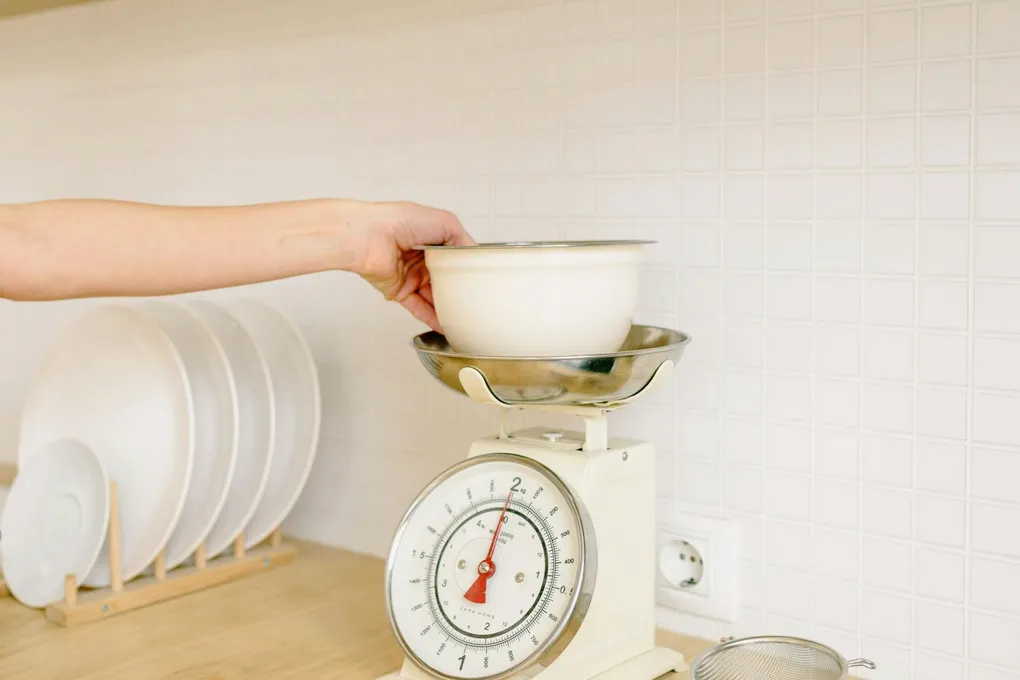
If you have ever tried to replicate a pizza recipe and gotten a completely different result, the problem is almost certainly how the recipe was written. Volume-based measurements — cups, tablespoons, handfuls — are the single biggest source of failure in home pizza making. A cup of flour can weigh anywhere from 120 to 160 grams depending on whether you scooped, spooned, sifted, or packed it. That is a 33% variance from the same instruction.
Professional pizza makers and serious bakers solved this problem decades ago with a system called baker’s percentages (also called baker’s math). Once you understand it, you can read any dough formula from any source — Italian, American, competition-level — and know exactly what it is telling you.
What Are Baker’s Percentages?
Baker’s percentages express every ingredient as a percentage of the flour weight. Flour is always 100%. Everything else is relative to it.
Here is a basic pizza dough in baker’s percentages:
| Ingredient | Baker’s % | Meaning |
|---|---|---|
| Flour | 100% | The baseline. Always 100%. |
| Water | 65% | 65% of whatever the flour weighs |
| Salt | 2.5% | 2.5% of the flour weight |
| Yeast (instant) | 0.5% | 0.5% of the flour weight |
| Olive oil | 1% | 1% of the flour weight |
If you decide to use 500g of flour, then water is 325g (500 x 0.65), salt is 12.5g (500 x 0.025), yeast is 2.5g (500 x 0.005), and oil is 5g (500 x 0.01). If you want to make a bigger batch with 1000g of flour, every ingredient doubles proportionally. The ratios never change.
This is the universal language of dough. When Tony Gemignani publishes his 14 competition-tested dough formulas in The Pizza Bible, he presents every one in baker’s percentages. When the EU’s TSG (Traditional Specialty Guaranteed) certification defines Neapolitan pizza, it specifies ingredient ranges in percentages of flour weight. When Nathan Myhrvold’s team analyzed 1,800 pizza recipes for Modernist Pizza, they compared formulas using baker’s percentages.
Why Volume Measurements Fail
Flour packing varies wildly. The same measuring cup yields different weights depending on technique, humidity, whether the bag was recently shaken, and even altitude. Ken Forkish, in both The Elements of Pizza and Flour Water Salt Yeast, insists on weight-based measurement as non-negotiable. As Gemignani puts it in his “Ten Commandments of Pizza”: Thou shalt use a scale to weigh ingredients.
Small ingredients matter enormously at small quantities. The difference between 0.1g and 0.3g of instant dry yeast is the difference between a 24-hour cold ferment and a dough that over-proofs in 8 hours. You cannot measure 0.1g with a teaspoon. You need a precision scale (0.1g resolution, about $13).
Recipes do not scale volumetrically. Doubling “2 cups of flour” does not produce dough with the same properties as the original batch, because your scooping inconsistency compounds. Doubling “500g of flour” produces exactly the same dough, every time.
How to Read Any Recipe in Baker’s Percentages
Take any recipe you encounter and convert it:
- Identify the total flour weight. If multiple flours are used (e.g., 00 flour + semolina), add them together. This combined total is your 100%.
- Divide every other ingredient by the total flour weight.
- Multiply by 100 to get the percentage.
Worked Example: Forkish’s 24-48 Hour Cold Retard Dough
From The Elements of Pizza:
- 500g 00 flour
- 350g water
- 13g salt
- 1.5g instant dry yeast
Convert:
| Ingredient | Weight | Calculation | Baker’s % |
|---|---|---|---|
| Flour | 500g | 500/500 | 100% |
| Water | 350g | 350/500 | 70% |
| Salt | 13g | 13/500 | 2.6% |
| Yeast | 1.5g | 1.5/500 | 0.3% |
Now you can immediately compare this to any other formula. Gemignani’s Master Dough with Starter, for instance, runs 61.8% hydration, 2.2% salt, and 0.49% active dry yeast. At a glance, you can see Forkish’s dough is wetter, saltier relative to Gemignani’s, and uses less yeast — which tells you it will handle differently and ferment differently.
The Key Percentages in Pizza Dough
Hydration (Water %)
This is the most consequential number in any pizza formula. It determines whether your dough is stiff and manageable or soft and extensible, and it directly affects the texture of the finished crust. For a deep dive, see our hydration guide.
- 55-60%: AVPN Neapolitan spec for 900F+ wood-fired ovens. Stiff, easy to handle, sets fast.
- 60-65%: Gemignani’s sweet spot. Workable for most home bakers across most styles.
- 65-70%: Forkish’s home oven range. Compensates for moisture loss during longer bakes at 550F.
- 70-75%: Pan pizza territory. Wetter, lighter crumb, focaccia-like.
- 80%+: Roman al taglio, advanced bakers only. Extremely sticky, requires stretch-and-fold technique.
Myhrvold’s team tested hydration ranges across every style in their 1,800-recipe database. Their Neapolitan master recipe landed at ~65%, New York at ~62%, and focaccia at a staggering ~87%.
Salt (%)
- 2-2.5%: Standard range for most pizza doughs.
- 3%: The AVPN Neapolitan spec. Higher salt slows fermentation, allowing room-temperature proofing all day without over-proofing — critical when you do not have refrigeration.
- Myhrvold’s recommendation: never vary salt for fermentation control. Salt is a flavor constant. Adjust yeast quantity instead.
Yeast (%)
- 0.01-0.08% IDY: Room-temperature Neapolitan (ambient ferment, 8-24 hours).
- 0.25-0.5% IDY: Long cold fermentation (24-72 hours in the fridge).
- 1%+ IDY: Same-day dough. Faster but less complex flavor.
Oil (%)
- 0%: Traditional Neapolitan and Forkish’s FWSY recipes. Crispier crust, more open crumb.
- 1-3%: Most American styles. Improves tenderness and shelf life.
- 4-10%: Deep-dish territory. Chicago deep-dish runs 8-9% fat (butter + lard).
Handling Starters and Pre-Ferments
Here is where baker’s percentages get slightly more complex. Gemignani’s recipes frequently include a Tiga (stiff pre-ferment at 70% hydration) or Poolish (liquid pre-ferment at 100% hydration). Forkish uses bigas and levains.
The flour and water in the starter count toward the total formula. Gemignani’s Baker’s Percentage chart accounts for this. His Master Dough with Starter lists 64% water, but the total hydration including the poolish’s water contribution is approximately 65%.
When converting a recipe that includes a pre-ferment:
- Calculate the flour and water contributed by the starter.
- Add that flour to your total flour and that water to your total water.
- Calculate percentages from the combined totals.
For Gemignani’s Poolish (47g flour + 47g water + 0.12g yeast), 47g of flour and 47g of water fold into the master formula’s totals.
Baker’s Percentages Across Styles
Here is what the major styles look like in baker’s percentages, synthesized across our sources:
| Style | Hydration | Salt | Yeast (IDY) | Fat | Source(s) |
|---|---|---|---|---|---|
| Neapolitan (wood-fired) | 55-65% | 2.6-3% | 0.01-0.08% | 0% | Masi TSG, Myhrvold, Forkish |
| Neapolitan (home oven) | 65-70% | 2.2-2.6% | 0.3-0.5% | 0-1% | Forkish, Gemignani |
| New York | 58-65% | 2-2.8% | 0.5-1% | 1-3% | Gemignani, Myhrvold, Forkish |
| Detroit | 70-75% | 2-2.5% | 0.5-1% | 1-3% | Gemignani, Myhrvold |
| Chicago Deep-Dish | 60-63% | 2% | 1% | 8-9% | Gemignani |
| Roman Al Taglio | 72-80% | 2-2.8% | 0.05-0.5% | 3-4% | Forkish, Myhrvold |
| Sicilian | 67-70% | 2-2.2% | 0.5-1% | 1% | Gemignani |
| Pan Pizza | 75% | 2.2% | 0.4-1% | varies | Forkish |
This table is the kind of comparison that only becomes possible when every recipe speaks the same language.
Practical Tips for Using Baker’s Percentages
Always weigh salt. Crystal size variation between Diamond Crystal kosher (9.6g per tablespoon), Morton kosher (17.6g per tablespoon), and fine sea salt makes volume measurement unreliable. One tablespoon of Morton contains nearly twice the salt of one tablespoon of Diamond Crystal.
Get two scales. A standard kitchen scale (1g resolution) for flour, water, and salt. A precision scale (0.1g resolution) for yeast. Forkish’s recipes use as little as 0.1g of instant dry yeast. You cannot wing this.
Record your results. When you find a formula you love, your baker’s percentages are the permanent record. If you switch from 00 flour to bread flour, you may need to adjust hydration (higher-protein flours absorb more water — roughly 1.5% more water per 1% protein increase, according to Masi’s flour rheology research). The percentages make this adjustment visible and trackable.
Temperature is the hidden variable. Baker’s percentages capture ratios, but not timing. The same formula produces very different results at 70F versus 80F ambient temperature. Masi’s research shows that a 1C increase in the 20-35C range accelerates fermentation by 8-12%. Track your dough temperature after mixing (target 75-82F for most formulas) alongside your percentages.
From Percentages to the Dough Calculator
Baker’s percentages are the conceptual foundation for any dough calculator tool. Once you understand the system, you can:
- Scale any recipe up or down by changing only the flour weight.
- Compare formulas across completely different sources and traditions.
- Diagnose what went wrong by comparing your formula against known-good benchmarks.
- Adjust a single variable (hydration, salt, yeast) while holding everything else constant.
This is not just a professional convenience. It is the difference between following recipes blindly and understanding what your dough is actually doing.
Sources: Forkish, The Elements of Pizza (2016); Forkish, Flour Water Salt Yeast (2012); Gemignani, The Pizza Bible (2014); Masi et al., The Neapolitan Pizza: A Scientific Guide (2015); Myhrvold & Migoya, Modernist Pizza Vol 1 (2021); Iacopelli, YouTube (2019-2023).